


Brewery & Taproom Drainage
Drainage by Application · Food & Beverage
Brewhouse, cellar, packaging and taproom drainage need different specifications. Use the room-by-room guidance below to compare temperature, cleaning chemistry, solids, wheel traffic and finish requirements, and identify where a dedicated hygienic drainage system is needed.
Four rooms, four different water problems
Map the brewery by water stream and operating conditions before choosing drains. Brewhouse, cellar, packaging and guest areas can share a building while needing different collection, cleaning and traffic specifications. This guide uses US accessibility and discharge references; the adopted plumbing code and local sewer authority determine project requirements.
The hot side can expose drains to hot cleaning solution and accidental process spills. Record the temperature at the drain, contact time and cleaning chemicals; keep spent grain, hops and trub out of washdown wherever practical. The cellar needs drainage for washdown and incidental condensation, with controlled collection of yeast and concentrated beer waste. Persistent dampness and standing residue make cleaning and drying important in both areas.
Packaging combines rinse water, potential glass or can debris, and sometimes hard-wheel pallet jacks or forklifts. Evaluate traffic and sanitation together. The taproom needs accessible, slip-resistant walking surfaces plus appropriate receptors for bar equipment. Guest areas, the back bar and any kitchen may need different drains; appearance does not replace hydraulic capacity or cleaning access.
Include the grain handling pad, keg dock, beer garden, patio and roof in the drainage plan. Clean rainfall may follow the approved stormwater route; grain leachate, beer spills and washwater require separate evaluation. See hardscape drainage and dock drainage.
What a brew day actually puts on the floor
Size each collection zone from measured or equipment-specified peak discharges and the events that can occur together. Daily water consumption is useful for water management, but does not establish a floor drain’s peak flow.
For an illustrative 20 bbl batch, 31 US gallons per barrel gives 620 gallons of beer. An assumed 5:1 water-use ratio would mean 3,100 gallons used, but the difference is not all floor runoff: product, evaporation, recovery and piped wastes follow different paths. For a specific discharge, 300 gallons over three minutes averages 100 gpm; a freely draining tank can peak above that average. Measure hose output with its actual nozzle and operating pressure, and obtain keg-washer discharge data. Add only credible simultaneous flows at each drain, or document controls that prevent overlap.
Outside, 1,000 sq ft receives about 623 gallons per inch of rain; 6,000 sq ft receives roughly 5,600 gallons in 1.5 inches, before losses. Peak rate is a separate calculation. As an illustration, the Rational Method Q = 1.008CiA (Q in cfs, i in in/hr, A in acres) gives about 118 gpm for a 3,000 sq ft slab (0.069 acres), an assumed runoff coefficient C = 0.95 and rainfall intensity i = 4 in/hr. These are example inputs, not a local design storm. Choose the jurisdiction’s recurrence interval and an intensity appropriate to time of concentration; evaluate bypass and blockage. Keep roof leaders and any required secondary roof drainage in the building’s roof-drainage design. Use our Runoff Calculator and runoff method guide for preliminary work.
A trench can intercept washdown along an aisle and simplify one-way floor falls. A sanitary point drain or box drain can be a better fit beneath a concentrated discharge or in a small room with defined falls, with fewer channel joints to clean. An approved floor sink can receive indirect equipment waste where required. Neither point nor linear drainage corrects a slab low spot elsewhere: survey existing elevations and confirm the flow path, equipment access and wet/dry boundaries before cutting the floor.
Check inlet capture, channel conveyance, outlet and basket restrictions, pipe capacity, traps, downstream water level and safe overflow together. A nominal 4-inch outlet has no universal 100-gpm limit. More outlets or a larger connection help only when the downstream system can accept the flow. Use actual geometry, slope, available head and manufacturer hydraulic data; provide cleaning access wherever restrictions are likely.
Set floor falls, channel invert and grate elevation as separate details. Design production-floor falls for the finish, washdown procedure and equipment stability. For scale, 1/8 inch per foot is about 1%; this is an illustration, not a universal code minimum. Accessible walking surfaces have a maximum 1:48 cross slope, so a nominal 1/4 inch per foot leaves no construction margin. ACO KlassikDrain sloped sections provide 0.5% invert fall (0.06 inch per foot); NDS Dura Slope sloped sections provide 0.7%, while neutral sections are level. Follow the exact drain installation detail for recess, concrete support, reinforcement and joints, and coordinate the floor coating or waterproofing connection. A generic grate recess does not establish load capacity or accessibility.
Hydraulic examples are screening estimates, not rated system capacities. Check actual internal diameter, roughness, design head, losses, and tailwater using the FHWA drainage design method and the selected manufacturer’s data.
Coordinate collection, treatment and hygienic requirements
Agree on collection routes and discharge acceptance before selecting outlets. Separating water streams can change both the drain specification and the treatment required.
Subsurface systems around the building
Subsurface drainage collects water within the soil; a surface channel intercepts runoff across paving. A conventional French drain uses a permeable trench with a collection pipe where needed. NDS EZflow is a gravel-free French-drain option in the manufacturer’s wider range. Ask us to confirm availability and the appropriate configuration rather than substituting a surface channel. Soil, outlet elevation, excavation and installation details still govern the design. French drains and infiltration systems are not disposal routes for brewery process waste.
Process wastewater, stormwater and pretreatment
Keep clean stormwater separate from process washwater, CIP chemicals, spent beer and grain-area leachate. Confirm the receiving sewer or other permitted disposal route and the local limits for flow, temperature, pH, suspended solids and organic loading. Capture grain, hops and yeast before rinsing; segregate concentrated beer and first rinses where practical. Screening removes coarse solids but does not remove dissolved beer sugars. Equalization, cooling, pH adjustment or further treatment may be needed. The Brewers Association wastewater manual explains these brewery-specific decisions.
EPA’s national pretreatment prohibitions apply to nondomestic discharges to public treatment works, and local limits may be tighter. EPA’s 104°F limit concerns temperature at the treatment plant; it is not a universal brewery outlet allowance. Provide sampling and maintenance access where required. A kitchen may also need grease interception, assessed separately from brewery process waste. Route glycol and chemical spills to the facility’s approved containment/disposal procedure.
An ACO oil-water separator may be relevant to an identified oily vehicle-area stream, but does not treat dissolved organics or neutralize CIP waste. Review ACO’s separation equipment only for the appropriate stream, including the effects of detergents and emulsified oil.
Hygienic interior drainage
For brewhouse and cellar washdown, review the ACO sanitary stainless range already listed on Drainage Connect. Modular grated channels, SlotDrain, FloorDrain and BoxDrain serve different collection needs; select the body, outlet, grate and floor connection together. Josam also manufactures stainless floor and trench drains; ask us to confirm the required model and availability. Hygienic design and chemical compatibility need project-specific documentation. A stainless grate or edge rail on a general-purpose trench does not establish suitability for a sanitary production area, and no family name guarantees every certification.
Specify accessible baskets, removable covers or slot-cleaning tools, cleanable joints, and a floor-to-drain connection compatible with the coating or membrane. Keep the cleaning route away from exposed product and clean equipment. Choose an openable channel when direct inspection and hand removal of solids are priorities. For a low-profile slot layout with dedicated cleaning equipment, Slot Drain Systems offers brewery channels with cleaning paddles and optional Flush Flo flushing. This outside-catalog option is worth comparing when that cleaning arrangement fits the operating procedure; flushing does not replace inspection, solids removal or sanitation verification.
Reading the load: kegs, hand trucks and forklifts in kN
Record the loaded equipment’s actual wheel and axle loads, wheel material and footprint, crossing angle, speed, braking and turning. These conditions and the complete installed assembly determine the specification. EN 1433 expresses the following test classes in kilonewtons; the classes are not wheel-load allowances:
| Class | Test force | Installation context |
|---|---|---|
| A15 | 15 kN | Areas used only by pedestrians and cyclists. |
| B125 | 125 kN | Pedestrian areas, car parks and parking decks; verify the product and traffic. |
| C250 | 250 kN | Kerb and edge-of-road locations; not a blanket truck-aisle or forklift specification. |
| D400 | 400 kN | Road traffic lanes and parking areas, subject to the selected assembly and installation. |
| E600 | 600 kN | Locations with high wheel loads, with project-specific design and manufacturer confirmation. |
| F900 | 900 kN | Locations with exceptionally high wheel loads, with project-specific design and manufacturer confirmation. |
EN 1433 class numbers state a test force in kilonewtons, not a permissible vehicle weight. NDS letter classes use separate pressure and traffic recommendations; NDS Class B does not establish EN 1433 B125. H-20, HS-25 and AASHTO M306 also require their own applicable documentation. Do not use a letter match, PSI conversion or an EN-to-AASHTO shortcut as evidence of compliance. See the load recommendation guide.
Small hard wheels can concentrate load on a few grate bars, while impact, braking, fatigue and inadequate support can also cause failure. Obtain forklift axle-load data at the actual carried load and check pallet-jack and keg-truck wheels separately. Do not derive a grate selection from forklift lifting capacity, a generic keg weight or a pressure conversion alone.
A recurring broken or loose grate calls for inspection of the grate, seating, locks, edge rails, channel and surrounding slab. Substituting metal or moving up one class will not repair damaged support or make an incompatible assembly suitable. Follow the selected manufacturer’s installation and load documentation; record the specified grate and channel part numbers together.
Hot side, cold side: choosing the channel material
Compare the complete wetted assembly against the cleaning schedule. Material names alone do not establish temperature, chemical or hygienic suitability:
| Body material | Heat behaviour | Caustic / acid | Candidate use |
|---|---|---|---|
| Plastic channelsNDS Dura Slope, Pro Series and profile channels | Materials vary by model: Dura Slope is polyethylene, the 5-inch Pro Series is polypropylene, and Mini Channel is PVC. No shared 180°F continuous-use rating should be assumed. | Check the exact resin, concentration, temperature and exposure time, including gaskets and grate materials. A chemical chart is not a structural rating under hot wheel loads. | Compare for suitable patios, exterior aprons and general drainage; require specific confirmation for process discharges. |
| Polyester polymer concreteACO KlassikDrain, PowerDrain | ACO’s published polymer-concrete guidance gives a maximum operating temperature of 180°F (82°C); verify the selected system and exposure. This does not qualify near-boiling dumps. | Use the concentration/time-specific resistance chart and compatible joint sealant. Hot caustic or acid cycles need manufacturer review. | General-purpose and exterior areas where traffic and chemistry fit; not the default hygienic hot-side channel. |
| Fiber-reinforced HPCBG Filcoten | High-performance concrete: obtain the selected assembly’s thermal and thermal-shock limits. | Mineral construction does not establish compatibility with CIP chemicals. Confirm the actual acid, alkali and sanitizer exposures. | Compare listed Filcoten systems for general surface runoff; verify grate, rail and installation requirements for traffic. |
| Stainless steel bodyACO sanitary stainless; suitable Josam systems | A candidate for hygienic process drainage, with temperature limits checked for seals, outlets and floor joints as well as steel. | Select 304 or 316L using the manufacturer’s chemical data. Neither grade is universally resistant to chlorides, oxidizers or concentrated cleaning chemicals; see ACO’s alloy-selection guidance. | Wet production, sanitary point collection and indirect-waste receptors as appropriate to the specific product. |
| Stainless edge railACO KS-series general-purpose channels | An edge rail is one component, not a stainless channel body. The polymer-concrete body and joints retain their own limits. | Check corrosion resistance of the rail, grate, locks and sealant separately. | Edge protection where the complete general-purpose channel is suitable; does not establish hygienic construction. |
Measure temperatures reaching the drain during normal operation, short hot discharges and cleaning. Submit chemical names, concentrations, contact times and rinse procedures. Review the NDS channel material specifications, Mini Channel’s PVC specification, and ACO’s polymer-concrete chemical guidance. Obtain current written confirmation for steam, thermal shock or chemical exposures outside published data.
Grates: pick from the section that already exists
Start with the matching channel grate range, then compare traffic rating, corrosion, opening geometry, slip resistance and cleaning. Ductile iron can suit heavy exterior traffic; stainless steel may better fit sanitation requirements. Decorative and brass patterns still need the same checks. An alloy name or a metal replacement alone does not establish the assembled load rating.
Compare systems zone by zone
Use these listed product families as a shortlist after flow, discharge and sanitation decisions. Listings establish catalog coverage; confirm price, availability and the exact configuration before ordering.
Sanitary stainless channels for wet production
Wet production requires a purpose-built drainage review
For the kettle, whirlpool and CIP area, compare ACO Modular 125 and Modular 200 grated channels with SlotDrain 20 where slot access suits the cleaning plan. ACO’s SlotDrain 20 documentation includes a brewery application and 304/316L options. Its standard 20-mm opening is wider than the ADA maximum; specify the documented accessible variant where needed. Compare FloorDrain or BoxDrain at concentrated collection points. Select the outlet and solids basket for the actual peak flow and cleaning access.
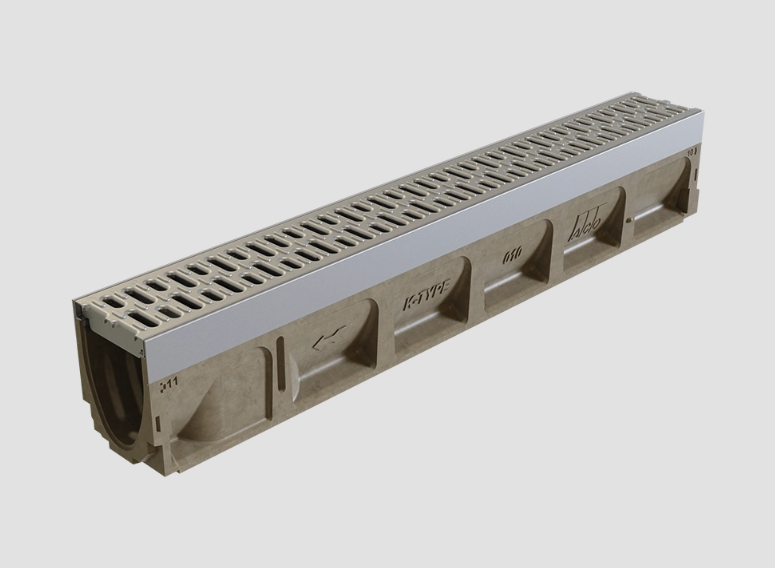
ACO KlassikDrain K100 / KS100Quote-Only
General-purpose surface collection · 4" polymer concrete
K100/KS100 provides a nominal 4-inch internal-width polymer-concrete channel with 0.5% sloped and constant-depth sections. K100 uses galvanized edge rails; KS100 uses 304 stainless rails. Compare for general-purpose areas whose heat, chemistry and hygiene requirements fit the system. A rounded invert assists flow but does not guarantee removal of trub or residue. Compare K200/KS200 and K300/KS300 when hydraulic calculations support more channel area, with outlets and downstream capacity checked too. Request the complete assembly quote.
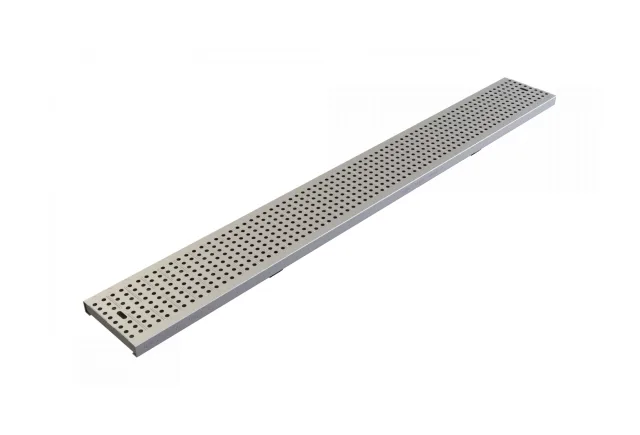
KS100 with a stainless mesh grate, or ACO BrickslotQuote-Only
Guest areas and paved patios · verify the exact opening pattern
For a guest-facing floor line, select a grate documented for accessibility, cleaning and the floor finish. Under ADA 302.3, openings cannot pass a sphere larger than 1/2 inch, and elongated openings must run perpendicular to the dominant direction of travel. “Heel-resistant” is a separate product feature. ACO’s heel-resistant Brickslot 100 offers twin 8-mm slots and maintenance access units for compatible paver installations. Check floor-build-up depth, access spacing and slot orientation; do not continue this general-purpose system into production solely to keep the appearance consistent.
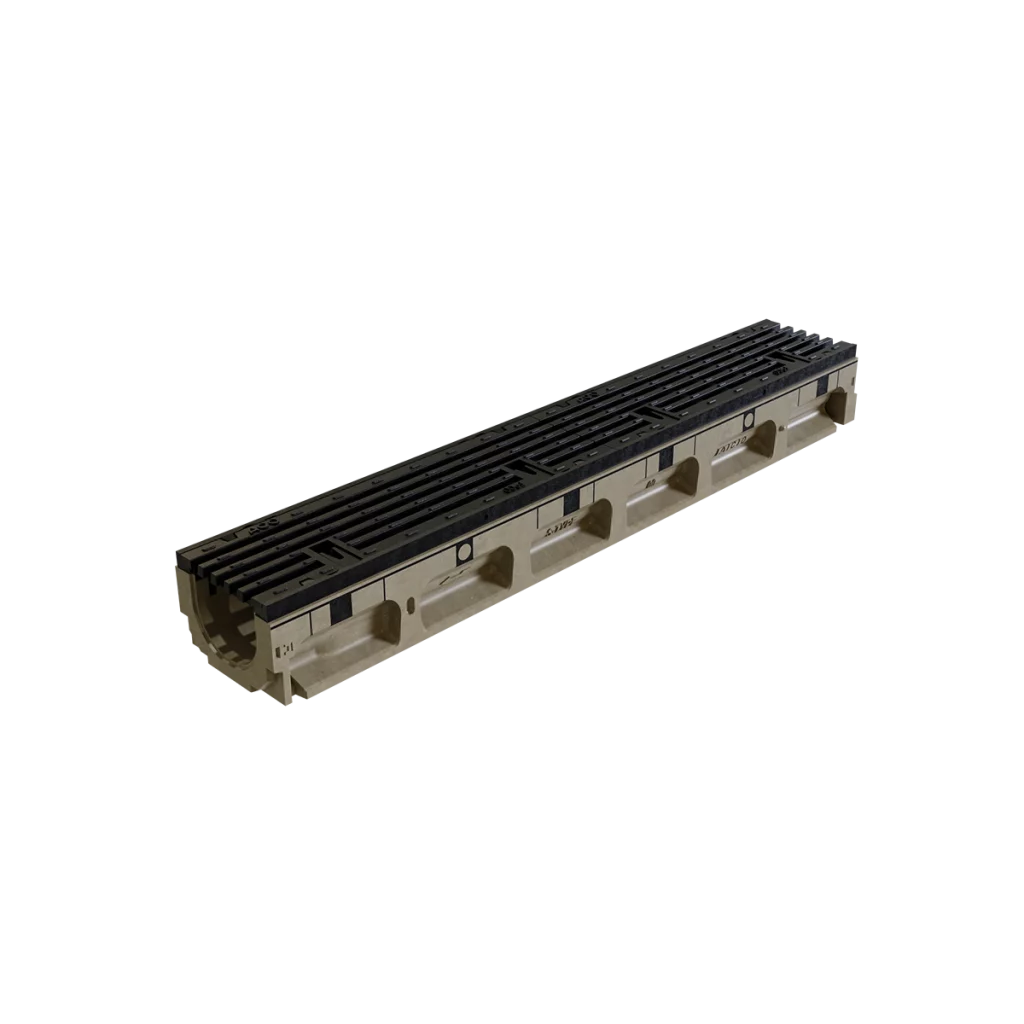
ACO PowerDrain S100K / S200K / S300KQuote-Only
Keg docks and traffic routes · engineered assembly selection
For repeatedly crossed vehicle routes, compare the specified PowerDrain channel, ductile-iron rails, grate and locking arrangement together. PowerLok and bolted grate options differ by model; inspect retention during maintenance. The manufacturer’s heavy-duty range includes assemblies up to EN 1433 F900, but that maximum is not a rating for every configuration or a direct vehicle-weight allowance. Compare S100K, S200K and S300K for flow and installation depth. In wet packaging, also compare sanitary stainless assemblies meeting the traffic requirement.
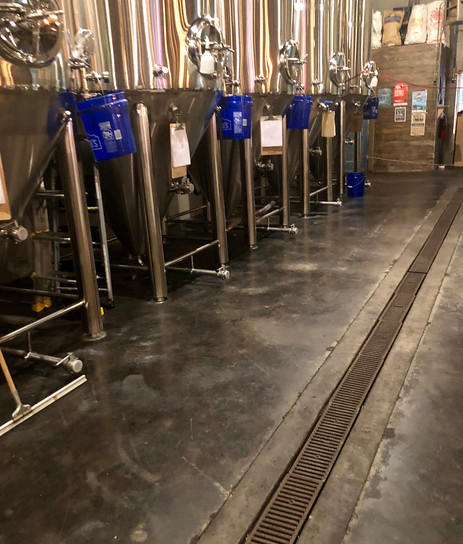
NDS Dura-SlopeCheck Listing
Patios and general runoff · sloped sections at 0.7%
For an NDS Dura Slope installation using the ductile iron frame, specify the matching grate and the manufacturer-required fasteners. NDS specifies DS-123 frame-to-channel screws and #629 grate-to-frame screws for DS-200H; do not assume the standard ProFit arrangement applies to this configuration. Confirm the complete assembly and installation detail for the wheel load, tire type, speed and crossing frequency.
NDS 5" Pro Series & Mini ChannelCheck Listing
Existing systems and shallow layouts · verify fit before replacement
For an existing NDS installation, identify the channel model, grate dimensions and depth, locking points, support condition and required load before ordering a replacement. Pro Series grates and Mini Channel grates are model-specific; a metal grate cannot upgrade a damaged or unsupported channel by itself. Compare listed 3-inch, 5-inch, 8-inch and 12-inch Pro Series and shallow Slim or Spee-D options for suitable general drainage. Shallow bodies save excavation depth but still need slab support and enough outlet fall. MiniKlassik K50/KS50 is another compact general-purpose option, not a substitute for an approved bar-equipment waste receptor.
Catch basins and accessible solids collectionCheck Listing
Exterior low points · keep interior hygiene and plumbing separate
For exterior surface runoff, compare 12-inch, 18-inch and 24-inch basins, matching grates, risers and outlet fittings. Size for inflows, outlet capacity, sediment storage and maintenance access, rather than simply going up one nominal size at a junction. Check basket or strainer compatibility and flow restriction. Production rooms generally need a cleanable sanitary receptor, not a landscape catch basin. An accessory foul-air trap is not automatically an approved substitute for the building’s required trap, vent and trap-seal protection.
Also in the catalog: BG Filcoten, Josam Pro-Plus and Josam Lite Line provide additional general-purpose channel choices. Compare the specific body, rail, grate, lock and installation documentation rather than applying one load class to an entire brand. Josam’s wider stainless range includes retrofit liners and custom drainage; those options may help an existing slab or unusual geometry, with exact supply and sanitary details confirmed separately.
Brewery drainage questions we get
What load class does a brewery floor drain need?
For taprooms, packaging aisles and keg docks, record the heaviest loaded equipment, axle or wheel loads, tire type, crossing speed and turning or braking at the drain. Select the class required by the project and confirmed for the exact assembly. EN 1433 D400 covers road traffic locations; E600 and F900 address higher wheel loads when the design requires them. C250 is not a universal truck, forklift or fire-lane rating. Pedestrian and parking zones may use lower classes when their actual traffic permits. See the load recommendation guide.
How hot can the discharge be before the channel material matters?
Check normal and peak liquid temperatures at the drain, exposure duration and cleaning chemicals against the complete assembly. ACO’s published polymer-concrete guidance gives a maximum operating temperature of 180°F (82°C), so near-boiling liquid must not be assumed acceptable. Plastic limits vary by resin and model. Stainless process drains are another option, but seals, joints and outlets still need verification. Sewer discharge temperature limits are a separate requirement.
Do you sell sanitary or hygienic stainless floor drains for a brewery?
Yes. The catalog lists ACO sanitary stainless drainage, including Modular channels, SlotDrain 20, FloorDrain and BoxDrain. Confirm the exact body, alloy, outlet, grate, floor connection and any required certification. A stainless rail or grate on KlassikDrain is different construction and does not establish sanitary suitability. Listings do not establish inventory or suitability for every brewery.
Can I buy ACO KlassikDrain or PowerDrain online?
Use Request a Quote for the specified KlassikDrain or PowerDrain assembly. Send run lengths, loads, invert depths, outlets and grate preference, plus heat and chemical exposure where relevant. For NDS, Filcoten, basins and accessories, check the individual listing for purchase options and confirm price and availability before ordering.
What grate belongs in the taproom?
Choose an exact grate documented for the traffic, slip resistance, cleaning and accessible route. ADA limits openings to those that cannot pass a sphere larger than 1/2 inch and requires elongated openings perpendicular to the dominant direction of travel. Heel resistance is a separate feature. Mesh, decorative, brass or slot designs need individual checks; neither the material name nor “slot drain” establishes compliance.
How do we stop the taproom from smelling like the drain?
Inspect both residue and the plumbing. Remove collected solids and clean the channel, basket, grate underside and accessible outlet on a documented schedule. Check the trap’s water seal, required trap-seal protection, venting, blockages and damaged connections; a plumber should investigate persistent sewer odor. ICC explains trap-seal loss and vent protection. Slope and a radiused invert assist drainage but do not replace cleaning or a functioning trap.
Planning a brewery or taproom drainage project?
Send run lengths, traffic by room, peak flows, discharge temperatures and cleaning chemicals. We’ll review suitable options, confirm availability and lead times, and prepare a quote.
Prefer to talk it through? Call 803-324-3225, email [email protected], or use the contact form.