


Dumpster Pad Drainage
Drainage by Application · Commercial & Municipal
Dumpster pads collect wash water, sediment and possible leachate while carrying truck wheels, container casters or roll-off equipment. Choose covered containment or approved collection first, then establish discharge routing, load requirements and cleaning access before assembling the drain package.
Start with the waste stream and the approved destination
A dumpster pad can receive rain, container leaks, food residue, grease, litter and cleaning chemicals. Those streams need different controls. Keep container lids and drain plugs closed, repair leaks, collect used cooking oil separately, and sweep up solids before washing. EPA’s restaurant stormwater guidance recommends covered waste containers, prompt spill cleanup and regular collection.
Keep clean water separate. Route roof downspouts and uphill pavement runoff around the enclosure to their approved stormwater system. Parking runoff may need its own treatment. Rain that contacts waste is no longer equivalent to clean roof runoff; dilution does not establish permission to discharge it. Do not route leachate, greasy washwater or spills to a storm inlet, lawn, pop-up emitter or dry well as a disposal shortcut.
Establish the enclosure’s operating method before specifying a drain. A roof, intact containers and dry cleanup reduce the liquid requiring collection. A covered pad with no permanent floor drain may use a contained low area and attended wet-vacuum or mop recovery where the authority permits it. A regularly washed pad may instead need a sealed point or linear collector connected to approved storage, treatment or sanitary plumbing. An open pad needs an approved plan for contaminated rainfall as well as washwater.
Local examples show why one standard detail is not enough
Menifee’s published enclosure detail describes covered containment without a floor drain, removal of standing liquid, and a sanitary-drain alternative subject to water-district approval. Portland’s food-cart-pod requirements call for a covered, hydraulically isolated waste area with an internal sanitary drain. These are jurisdiction- and use-specific examples; confirm the current requirements for your project with the stormwater authority, sewer utility and building or health department.
Reading the enclosure detail
- Slab and apron: design thickness, reinforcement, joints and subgrade for the actual refuse truck, container supports and collection operation. Obtain the hauler’s vehicle geometry and service clearances; a generic slab thickness or concrete strength does not establish adequacy.
- Levels and containment: survey the gate, walls, existing pavement and proposed collector. An illustrative 1–2% pad slope may help drainage, but the adopted detail, container stability and accessible route govern. A raised threshold must also accommodate cart movement and accessibility; a four-inch curb across the entrance is not a universal fix.
- Collector location: use a point drain for a defined local low spot or a trench to intercept a line of sheet flow. Grade toward it, account for bypass at trench ends and keep service access clear when containers are in place. A full-width trench behind every container is unnecessary if another layout captures the water effectively.
- Roof and run-on: coordinate cover dimensions, gutters, door swing and lifting clearances. Grade exterior pavement away from the enclosure while retaining contaminated liquid inside its approved collection area.
- Named destination: show pipe routing, receiving elevation, any trap and vent requirements, backflow or backwater protection, pretreatment, storage and overflow response. Confirm discharge acceptance before fixing outlet depth.
Collection, pretreatment and disposal do different jobs
Solids and fats, oils and grease
A removable screen or sediment sump can retain coarse debris; neither makes leachate clean nor removes all fine solids, dissolved contamination or pathogens. Drainage Connect lists Josam Lite Line grease interceptors. The Josam JG-0100S family is a manually cleaned on-floor type. Where the sewer utility requires grease interception, confirm the exact model, accepted peak flow, grease and solids storage, wastewater temperature, access and cleaning requirements. Do not use a kitchen fixture rating alone to approve outdoor pad wastewater, or dump collected cooking oil into the drain.
Oil separation and spill containment
The catalog also includes ACO Oleopator, Spill Control and Aquaduct Double Containment. These merit review for their specific separation or containment duties, not as universal dumpster treatment. Oleopator uses gravity and coalescence to separate hydrocarbons and solids; it is not a substitute for food-grease interception. EPA explains that emulsifying cleaners can defeat oil-water separation and that spills should be captured at source. Isolate unexpected chemical spills and arrange appropriate recovery rather than washing them through pretreatment.
Approved disposal may mean sanitary discharge with conditions, or collection for off-site treatment. Obtain the receiving utility’s acceptance of the actual waste stream, flow and pretreatment; a drain connection or separator label is not approval. For storage, define working volume, pump-out access, alarms and the response to a full tank or failed pump. Any reuse system needs treatment matched to the source and intended use, with required cross-connection protection and an approved route for residual water, sludge and filters. EPA’s reuse guidance explains why treatment requirements vary with source and end use.
Food-service pads and hygienic rooms need separate assessments
A grocery’s organic-waste enclosure may have different grease, odor and cleaning demands from a warehouse’s dry-cardboard area. Evaluate actual chemistry and operations. For a kitchen or sanitary production room, the listed ACO sanitary stainless range offers point and linear collection options; assess hygienic details, floor connections and the exact assembly. A stainless grate or rail on an exterior trench does not make the whole drain sanitary.
Estimate both peak flow and stored volume
Illustrative rainfall case: a 12 × 20 ft open pad has 240 sq ft of exposed area. One inch of rain falling on it is 240 × 0.623 = about 150 gallons before losses. For a peak-flow screen using runoff coefficient C = 0.95 and intensity i = 2 in./hr, Q = 0.01039 × C × i × area gives 4.7 gpm. Select local design intensity and duration for the project; 2 in./hr is an assumption, not a nationwide design storm. See Sizing for Storms and the runoff calculator.
If another 6,000 sq ft of pavement contributes at the same intensity and coefficient, it adds about 118 gpm, making the combined peak approximately 123 gpm. Excluding run-on reduces both collection flow and the amount of contaminated water needing management; it does not remove rain falling directly onto an open pad.
Illustrative washing case: a measured 8 gpm hose used for 15 minutes produces 120 gallons. If it operates during the example storm, the pad-only instantaneous inflow is about 12.7 gpm. Use actual hose or pressure-washer flow, simultaneous equipment and batch discharges; do not substitute daily consumption for peak collection flow.
Illustrative storage case: capturing a full 1-inch event from that pad plus the 120-gallon wash requires about 270 gallons of liquid space before allowances, assuming no discharge during the event and conservatively retaining all rainfall. Actual required working storage also includes existing liquid, other inflows and the response interval, with separate freeboard and sludge allowances. A nominal tank size or curb height is not usable volume; calculate the sloped enclosure geometry and container displacement. Define a contained response to exceedance or equipment failure.
| Internal diameter | Approx. full flow | What the estimate excludes |
|---|---|---|
| 3″ | 40 gpm | Grate capture, clogging and end-outlet entrance losses |
| 4″ | 85 gpm | Fittings, traps, treatment restrictions and tailwater |
| 6″ | 252 gpm | Upstream channel depth and downstream surcharge |
| 8″ | 542 gpm | Storage, pumping, spill control and discharge acceptance |
These full, uniform gravity-flow calculations use Manning’s equation; they are not ratings for nominal outlet fittings or wastewater-pipe sizing approvals. Check inlet capture, bypass, channel conveyance, available head, outlet losses and receiving-system capacity together. FHWA HEC-22 provides the storm-drainage framework; approved plumbing and process design govern wastewater. A larger pipe does not correct an unapproved discharge.
Check trucks, casters, rollers and support loads separately
Record the actual loaded container, wheel count and material, caster dimensions, truck axle and wheel reactions, collection maneuver, turning and braking. Do not assume every front-load bin has casters or divide its total weight equally among four wheels: uneven paving and movement can change the load distribution. Grate response depends on contact area, bar span, impact, fatigue, lateral force and support, not contact pressure alone.
Keep trenches and basin covers clear of roll-off skid rails, roller paths, container feet, compactor supports and truck outriggers where practicable. If a crossing cannot be avoided, obtain a designed, manufacturer-accepted assembly for that actual concentrated load and movement. Do not treat a heavy-duty wheel-load class as permission to drop or drag containers across a drain.
Specify the governing test standard and class with the complete grate, channel, frame, restraints and installation. EN 1433 classes and NDS letter classes use different criteria; their letters are not interchangeable, and a grate’s proof load is not a permissible vehicle weight. Use the load recommendation guide with current manufacturer details. Structural slab and encasement design remain part of the installation.
Keep collection points accessible and materials compatible
Locate access deliberately. A sump may be within or outside the enclosure if its cover can be reached safely and its routing maintains separation. Do not automatically place an open basin in the truck apron or combine an external storm inlet with contaminated pad collection. Provide space to lift covers and remove retained solids without working under a suspended container. Basin dimensions follow sediment storage, hydraulics and cleaning access, not the number of dumpsters.
Compare actual openings. Wet cardboard and food residue can blind any grate or narrow slot. Match openings and orientation to the smallest caster, hand truck and pedestrian route while allowing practical cleaning. Where accessible-surface requirements apply, the U.S. Access Board limits openings to a ½-inch sphere and orients elongated openings across the dominant travel direction. That is not proof that every small caster will roll freely or that the grate will resist lateral abuse.
Check the entire wetted assembly. Waste liquid chemistry varies; record pH, fats, salts, cleaning-agent concentration, maximum temperature at the drain and contact time. Review channel resin or concrete, grates, rails, coatings, joints, seals and pipe together. Select materials using chemical-resistance data for the actual liquid; neither polymer concrete nor stainless steel has universal resistance. Seal and test joints where the approved containment design requires liquid tightness; concrete encasement alone does not provide it.
A separate subsurface drain may address clean groundwater outside the enclosure, where site conditions and discharge rules allow. A French-drain system such as NDS EZflow is not a collector or disposal route for contaminated pad washwater.
Build a compatible parts list
For an illustrative 20-foot Dura Slope channel run, begin with the approved collection layout and assembled elevations. This is a takeoff framework, not a pre-approved dumpster-pad package.
- Channel sequence: five four-foot sections make 20 feet of channel. Choose compatible sloped or neutral sections from the run drawing. A 0.7% slope gives about 1.68 inches of invert fall over 20 feet; excavation must still accommodate changing depth and required support.
- Grates, frame and restraints: select the exact assembly for the specified loads. Ten two-foot grates cover 20 feet, but frame lengths, fasteners and quantities must follow that configuration. Standard ProFit locks are not an assumed substitute for frame-specific hardware.
- Outlet components: choose compatible end caps, end or bottom outlet adapters, seals and pipe connections for the hydraulic design and available invert. Match fittings to the approved pipe material and use.
- Solids access: provide a compatible accessible sump or separate pretreatment structure. DS-240 fits the DS-340 basin, not channel sections, and NDS excludes its use with the DS-200H frame. A DS-340 basin adds two feet if placed in addition to the channel run. Including the basin within a fixed 20-foot footprint requires a revised channel takeoff.
- Complete downstream scope: include approved piping, any trap/vent arrangements, inspection access, pretreatment, storage, pump controls and disposal connection. Verify the slab, encasement, joints and containment details before ordering.
The current NDS catalog documents these components and compatibility limits. Its DS-091NDIKIT has an NDS Class C installation rating; buying a kit does not establish refuse-truck suitability. Obtain a matched current submittal where manufacturer documents differ on frame or hardware versions.
Compare products by the job they need to do
These catalog families serve different collection and access needs. Select by actual chemistry, geometry, loads and discharge design; confirm availability and the exact assembly for the project.
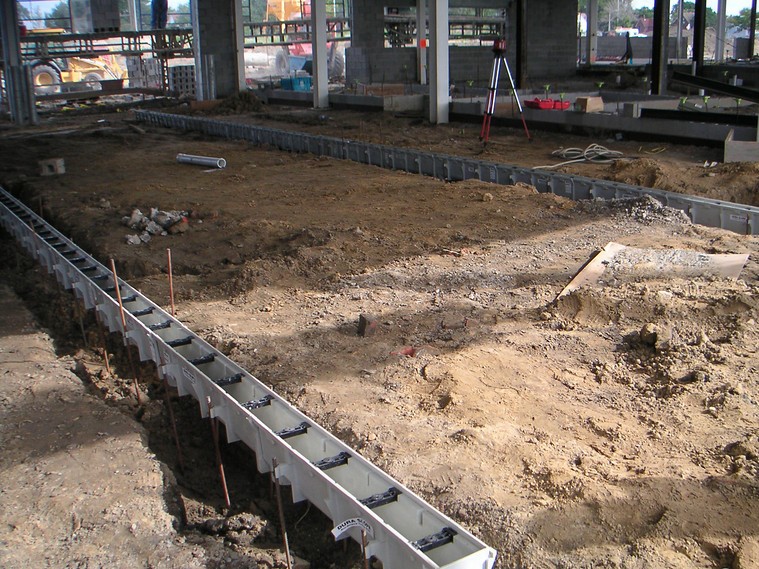
NDS Dura Slope with a matched metal grate and frame
Modular collection where the documented installation matches the traffic
HDPE channels offer a sloped modular layout. For heavier traffic, assess the DS-200H frame configuration, including current fastening details. NDS’s Class D guidance includes operation below 20 mph; it is not an EN D400 equivalence or approval for arbitrary skid, caster or support loads. Confirm temperature and chemical compatibility and the wastewater joint-sealing requirements.
Dura Slope galvanized Slot Top
Narrow surface opening where capture and cleaning access are sufficient
NDS specifies a ½-inch slot for DS-ST4 and publishes an NDS Class D installation rating. This is a raised slot assembly requiring its own pavement detail, not simply a plate substituted for a conventional grate. Evaluate caster orientation, metal compatibility and debris capture. Include accessible maintenance units and allow for their removal. Increasing pad slope does not compensate for a blocked opening; per-foot intake data is not whole-system capacity.
BG FILCOTEN TEC V 100 & PRO V 200
High-performance concrete channels with model-specific rails and installation
Compare the nominal 4-inch TEC V 100 and 8-inch PRO V 200 for channel depth, grate openings and service loads. The U.S. TEC V 100 sheet requires the documented full-concrete arrangement for D/E installations and excludes highway use. The PRO V 200 sheet identifies galvanized rails and sloped or neutral sections. Neither name establishes a cast-iron edge or roll-off skid suitability. Review actual wash chemicals rather than assuming a cement-based channel always loses to polymer concrete.
ACO PowerDrain S100K & S200K
Documented heavy wheel loads and robust edge construction
PowerDrain S100K and S200K use polymer concrete with cast-in ductile iron rails and offer configurations through EN 1433 Class F. They merit comparison where traffic exceeds a general-duty assembly’s limits. Choose the specific grate and installation: PowerLok boltless retention and four-bolt grates are different options, and tamper-resistant bolts belong to the applicable bolted configuration. The published wheel-load range does not establish resistance to dropped containers, dragged skids or unapproved support reactions.
Review the 4-inch or 8-inch channel against the hydraulic and outlet design, then request the specified package.
ACO KlassikDrain K100 & K200
General-purpose polymer concrete with varied grate options
Compare K100/KS100 and K200/KS200 when channel profile and grate choice suit the enclosure. ACO identifies galvanized or stainless edge rails and DrainLok or QuickLok options for K100/KS100. Match the selected grate, retention system and installation; do not assume every cover shares one class or opening pattern. Stainless rails do not change the polymer-concrete body into a stainless sanitary drain or prove compatibility with all detergents.
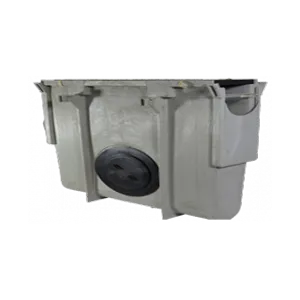
Point collectors, catch basins, risers & outlets
Local low spots and accessible sediment collection
A point collector may avoid an unnecessary full-width trench. Evaluate the listed 12-inch, 18-inch and 24-inch families against flow, sump storage and access. A plastic landscape basin with a cast-iron grate is not automatically a truck-rated or sanitary-approved receptor. Verify the body, riser, frame, joints, cover and support as one assembly, including required gas sealing and wastewater connections. Larger storage may change cleaning frequency, but cannot guarantee a quarterly interval.
Mi-T-M PWR portable water recovery
Portable recovery for attended washing where permanent drainage is unsuitable
A portable recovery system adds a different function from a buried drain. Mi-T-M’s PWR-10-0ME1 combines a berm, suction head, vacuum recovery and transfer pump for collected washwater. Consider this approach for an approved containment-and-recovery operation or a retrofit lacking an accepted drain connection. Confirm effective capture, transfer rate, receiving storage and filtration against the actual wastewater. Collection and filtration do not establish sewer-discharge or reuse approval.
The manufacturer’s operating manual excludes flammable pickup and aggressive solvents or detergents, and requires attended operation. It is not an unattended rainfall-control system. Arrange compatible treatment or disposal for recovered water and residues; confirm the equipment package with its supplier.
Install for the approved duty and keep it serviceable
Check installation, operation and cleaning together
- Complete support: follow the selected manufacturer’s load-specific encasement and anchorage detail, such as the ACO polymer-concrete installation manual, coordinated with engineered slab reinforcement, joints and subgrade. Neither concrete strength alone nor a grate label rates the installed system.
- Finished levels: use the manufacturer’s specified recess and pavement interface, coordinated with accessible transitions and caster movement. Verify recess dimensions for the selected drain and finish. Check capture and bypass with clean water before use.
- Contained service: check seals and connections, verify the destination, and commission pumps, alarms and any approved isolation controls. Confirm the response to blocked drains, full storage and freezing conditions; do not create an emergency overflow into the storm system.
- Cleaning plan: assign responsibility, inspect after collection and washing, remove litter and food residue before they enter the drain, and inspect after storms that affect the pad. Set sump, filter and interceptor service intervals from observed accumulation and their operating instructions. Remove solids for appropriate disposal, inspect restraints and damaged edges, then replace covers securely. Monthly or quarterly schedules alone cannot ensure performance.
Pads next to this one
- Loading dock drainage — coordinate adjacent service-area loads and drainage
- Restaurant & commercial kitchen drainage — where the grease, the interceptor, and the hygienic line get drawn
- Parking lot & retail site drainage — the run-on you keep off the pad still has to go somewhere
- HOA & property management drainage — coordinate enclosure inspection and maintenance across a property
Dumpster pad drainage FAQs
Where should the drain go on a dumpster pad?
First determine whether the approved design uses a permanent drain or covered containment with liquid recovery. For a drained pad, place a point collector at the designed low spot or a trench along the interception line, allowing for end bypass. Keep grates and service covers accessible and clear of container supports and drag paths where practicable. Basin location depends on access, loading and separation of clean and contaminated water.
Can a dumpster pad drain connect to the storm sewer?
Do not treat leachate, greasy washwater or chemical spills as clean stormwater. Keep roof drainage and run-on separate. Obtain approval for the actual pad wastewater and its destination; sanitary discharge may require pretreatment and a covered enclosure, while another project may use contained recovery for off-site treatment. A grate, sediment basket, grease interceptor or oil-water separator does not by itself make discharge acceptable.
What load class does a dumpster pad drain need?
Use the project’s specified standard and current documentation for the complete channel, grate, frame, restraints and installation. Include actual truck wheel and axle loads, container casters, rollers, feet and operating movements. NDS letter classes and EN 1433 classes are not interchangeable. Heavy wheel-load ratings do not automatically approve dropped containers, skids, outriggers or compactor supports.
How much water does a dumpster pad drain have to handle?
For an illustrative 240-square-foot pad at a 2-inch-per-hour rainfall intensity and runoff coefficient of 0.95, peak runoff is about 4.7 gpm. Another 6,000 square feet adds about 118 gpm. An 8 gpm hose adds its full flow while operating and produces 120 gallons in 15 minutes. Select local rainfall criteria and measured wash flows; size inlet capture, conveyance, treatment and any storage together.
Why do small container wheels matter when selecting a grate?
A hard caster or roller can concentrate a load on a small area, and dragging or turning introduces lateral forces. Truck wheels can impose much larger total loads. Contact pressure alone cannot rank them: use actual wheel reactions, contact geometry, bar span, impacts and support conditions. Avoid locating drains beneath container feet or skid paths unless the actual duty has been specifically accepted.
Does a dumpster pad need a French drain?
A French drain should not receive dumpster leachate, grease or contaminated washwater. A separate subsurface system may address clean groundwater outside the enclosure if site conditions and the approved discharge route allow it. Keep it isolated from the pad’s contaminated collection and containment system.
Can a dumpster pad operate without a permanent floor drain?
Where local requirements allow it, a roofed, contained pad can use dry cleanup and attended recovery of liquid for approved disposal. Provide a practical low point, sufficient working storage and a written cleaning and spill response procedure. This does not mean leaving stagnant water on the slab. An open pad also needs to account for contaminated rainfall; a portable vacuum is not an unattended storm drainage system.
Working from an enclosure detail?
Send the enclosure detail, pad dimensions, container type, discharge route and specified load requirements. We’ll review suitable options, confirm availability and lead times, and prepare a quote.
Building a single pad yourself? Shop NDS Dura-Slope or browse catch basins. Prefer to talk it through? Call 803-324-3225, email [email protected], or use the contact form.