


Fleet & Truck Wash Drainage
Drainage by Application · Transportation & Logistics
A fleet wash rack must collect scheduled equipment flow while carrying vehicles that stop and steer across the drain. Use the wash equipment schedule, traffic and downstream treatment elevations to define the trench and outlet requirements.
Start with the fleet and the wash process
A transit depot may wash buses in a drive-through lane; a public works yard may use an open pad for salt-covered plow trucks; a construction fleet may need to remove heavy clay before detergent washing. These are different drainage duties. Record the vehicles, equipment stages, mud and grit, cleaning products, and operating schedule before choosing a channel.
Wash water can contain detergent, road salt, oil, metals and suspended solids. Treat the wash area as a wastewater collection zone even when washing occurs outdoors. Clean roof water, surrounding yard runoff, vehicle exterior washing, tank interiors and concrete washout need separate assessment.
For retail tunnels and self-serve bays, see car wash drainage. For a rack within a motor pool, also see military base drainage.
Five connected jobs on a wash pad
Confirm the approved wastewater destination before fixing the slab, trench and equipment elevations. Sewer acceptance, permitted treatment/discharge, reuse with managed residuals, or contained collection for off-site disposal lead to different layouts. A sanitary connection is not automatic permission to discharge.
Collect process water
Use an impermeable, graded wash area with sealed collection joints appropriate to the waste stream. A linear drain can intercept a broad sheet of water; point drains or a collection sump may work where the floor grades converge. Select catch basins and fittings for wastewater compatibility, access and traffic support, not simply for their outlet size.
Keep surrounding stormwater out
Roofing, curbs and grading can reduce rainfall entering the wash-water system. Route clean roof and yard runoff separately where the approved site plan allows. Rain falling on a contaminated wash pad may itself need collection and treatment; do not switch it to a storm outlet solely because washing has stopped. EPA’s municipal washing guidance describes containment, treatment, reuse and local pretreatment considerations.
Separate solids and treat the actual contaminants
Drainage Connect lists ACO Oleopator and Spill Control oil-water separators. Compare the exact model’s treatment flow, solids storage, oil duty and access with the process. A free-oil separator does not remove every contaminant: detergents can stabilize oil emulsions, and dissolved salts require a different treatment approach. Excess flow also reduces separation performance. See EPA’s fleet oil/water separator guidance and ACO’s separation range.
Coordinate pumping, reclaim and special waste
If gravity cannot reach the receiving equipment, design a pumped collection system with solids handling, operating storage, high-level indication and a response to pump failure. Reclaim equipment must be matched to the wash process; a drain or separator alone is not a recycling system. Keep ready-mix drum/chute washout separate in suitable leakproof containment or a designed washout system, with managed water and solids recovery. See EPA concrete washout guidance.
Keep subsurface drainage separate
A French drain collects groundwater through a permeable trench. It is not truck-wash disposal. For a separate groundwater problem, a conventional gravel-and-pipe drain or NDS EZflow may be evaluated against soils, elevations and an approved outlet. Prevent process water from entering that system.
If your fleet hauls food or chemicals
Exterior fleet washing and tank-interior cleaning are different waste streams. Identify previous cargo, cleaning and sanitizing requirements before connecting them. For hygienic wet rooms, compare the ACO sanitary stainless range with the floor connection, cleanability, chemistry and loads required. Josam stainless drainage offers another manufacturer range to evaluate. A stainless grate on a composite trench does not make the body sanitary stainless or suitable for truck wheel loads.
Size for actual peak discharge and the receiving system
Map where spray and undercarriage runoff land, then grade the slab to capture them without ponding beside the vehicle. Choose slopes around equipment requirements, floor finish, accessible routes and available elevations. A wider bay may benefit from a centerline drain or multiple collection lines, but bay width alone does not determine the layout. Check inlet capture at the expected sheet depth and approach velocity; a rough finish or wider grate does not guarantee capture.
- Build a simultaneous operating schedule. Include wands, rinse arches, underbody jets, equipment drains, tank dumps, reclaim backwash and any hose-down that can coincide. Use measured discharge or the equipment supplier’s peak flow and duration. A brief tank dump may govern even if average nozzle demand is low.
- Keep fresh-water consumption separate. Recycled water still reaches the collection system. Size each stage for the flow actually passing through it, including reuse loops, rather than multiplying fresh gallons per vehicle by vehicles per hour. EPA WaterSense’s vehicle-wash guidance distinguishes fresh water, process flow and reclaim treatment.
- Account for rain that enters containment. Evaluate concurrent rainfall and washing where they can occur together, plus storm storage and equipment outages. Choosing only the larger of storm flow and wash flow can undersize a shared collector. Use the runoff calculator and Sizing for Storms for rainfall inputs; keep unrelated yard runoff outside the process system.
Illustrative arithmetic: two 5-gpm wands plus a 60-gpm arch operating together discharge 70 gpm before other sources. A hypothetical 16 × 60 ft impermeable pad receiving 2 in/hr rainfall adds about 20 gpm (960 × 2 × 0.623 ÷ 60), assuming all rainfall runs off to that collector. The combined rate is about 90 gpm. These are example inputs, not typical equipment ratings or a selected design storm.
A continuous 30-gpm process operated for six hours moves 10,800 gallons through collection; it need not consume that much fresh water if water is reused. Use daily totals for storage, water balance and residuals planning. Estimate sediment loading from actual solids, not gallons alone.
| Assumed inside diameter | Calculated flow | Limit of this comparison |
|---|---|---|
| 4″ | ~85 gpm | Ideal straight-pipe conveyance; not an outlet rating |
| 6″ | ~250 gpm | No entrance, bend or separator losses included |
| 8″ | ~540 gpm | No receiving-water backwater included |
| 10″ | ~980 gpm | No allowance for sediment or blockage |
| 12″ | ~1,600 gpm | Not permission to combine yard and wash drainage |
These screening calculations use Q = (1.486/n)AR2/3S1/2 in ft³/s, with A = πD²/4, R = D/4, D in feet and 1 ft³/s = 448.83 gpm. They assume steady uniform flow in a full circular pipe. Actual internal diameter, roughness, head, losses and tailwater change the result. See the FHWA urban drainage design manual.
Check grate capture and bypass, channel depth, outlet connections, pipe hydraulics, treatment rate, sump/pump controls and receiving level together. If inflow exceeds treatment flow, provide designed equalization storage and controlled release rather than assuming the trench provides that storage. Built-in channel slope helps conveyance but does not guarantee that clay or grit will remain suspended; provide reachable solids collection and cleanout points.
Match the installed assembly to truck movements
Record the heaviest actual service vehicle, axle and wheel loads, tire type and contact area, crossing speed, and turning or braking at the drain. Include loaded trucks and off-road equipment rather than relying on a highway gross-weight limit. Repeated stopping, steering and wheel crossings must be considered in the grate retention, frame support and surrounding slab.
EN 1433 class numbers describe a test force, not permissible truck weight. NDS letter classes use separate traffic guidance; NDS Class D is not automatically EN 1433 D400. H-20, HS-25 and AASHTO M306 also require their own applicable documentation. Do not use a letter match or PSI conversion as evidence of compliance. See the load recommendation guide.
Compare heavy-duty assemblies for the wheel paths and approach lanes, and select the standard and class required by the project. The rating depends on the matched channel, grate, frame, retention hardware and concrete support. A stronger grate cannot upgrade an unsupported basin or an incompatible channel assembly. Pedestrian-only areas may use different covers, provided vehicles are physically excluded.
For each drain and sump, obtain the manufacturer’s installation detail for the intended traffic: concrete dimensions and reinforcement where specified, subgrade, joints, grate elevation and anchorage. Keep the required locks fitted after every cleaning and replace worn components with matched parts.
Check the complete system against wash chemistry
Identify the formulation. Submit the detergent, degreaser, brightener and disinfectant SDSs, in-use dilution, spill concentration, contact duration and wastewater temperature. pH alone does not establish compatibility. Acid brightener, alkaline cleaner, road salt and oily reclaim water can affect the channel body, coatings, rails, grates, fasteners, sealant and pipe differently.
Do not select by material name alone. Stainless steel is not universally acid- or chloride-resistant; ductile iron and fiber-reinforced concrete are not blanket substitutes for galvanized parts in an acid bay. Josam’s Pro-Plus chemical chart, for example, lists specific non-resistant exposures rather than universal chemical resistance. Obtain written compatibility for the actual complete assembly where the formulation or operating conditions are not covered.
Check temperature at the drain. Nozzle temperature can differ from liquid temperature at the inlet. Include sustained hot washing, hot tank dumps, cold rinses and exposure duration when checking body, joint and seal limits. Do not dismiss corrosion as cosmetic without inspecting section loss, grate seating and retention hardware.
Compare grates, including ductile iron and other metal options, using the exact channel fitment. Larger openings can pass coarse debris but increase the downstream solids burden; fine patterns can clog and need accessible cleaning. Evaluate wet traction and workers’ footwear. Where accessible surface requirements apply, openings must not pass a sphere over 1/2 inch and elongated openings must run perpendicular to the dominant travel direction; see ADA §302.3. An ADA opening claim does not establish slip resistance or the assembly’s load class.
Choose a layout that can be contained and cleaned
Longitudinal, transverse or point collection. A centerline trench shortens the sheet-flow path from both sides but may be inaccessible beneath a parked truck. Transverse drains can intercept specific spray zones. Point drains need floor grades that reliably deliver water to them. A full-length trench is useful when the collection pattern needs it; it is not mandatory for every long bay.
Threshold and perimeter protection. Use grades, curbs or berms with the collector to keep wash water inside and unrelated runoff outside. A threshold grate alone cannot guarantee containment during bypass, blockage or pump failure. Define the high-water boundary and response to failure; do not direct emergency overflow to an unapproved storm outlet.
Accessible sediment collection. Put coarse solids traps or sumps where staff can remove debris with safe lifting or vacuum equipment. Basin kits and outlet fittings must match the body, load and wastewater duty. A basin does not become a second functioning outlet without a designed connection, and multiple openings do not guarantee effective settling. Keep raised landscape grates outside vehicle and walking paths; assess every flat grate and basin by its documented assembly rather than banning or approving all plastics.
Compare products by their role on the rack
These Drainage Connect product families address collection and related equipment. Compare installed cost, traffic, chemistry, hydraulics and maintenance access using the same criteria; confirm the exact configuration and availability before ordering.
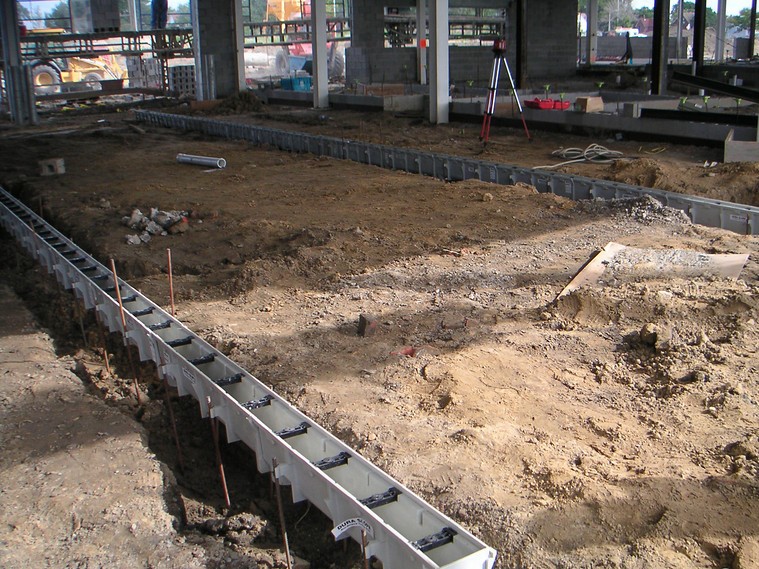
NDS Dura Slope — modular collection where the assembly fits
HDPE channel · confirm traffic, temperature and chemistry
Dura Slope offers four-foot sections with 0.7% sloped and neutral options. Check the actual sequence and deepest invert. For heavier traffic, compare the documented DS-232 grate and DS-200H frame assembly, hardware and encasement; NDS’s Class D guidance includes a speed limit below 20 mph. Do not infer suitability from body material or vehicle name alone. DS-240 fits the DS-340 basin, not channel sections, and is not for use with the DS-200H frame. Provide a separate compatible solids collector where needed. See the current NDS channel catalog.
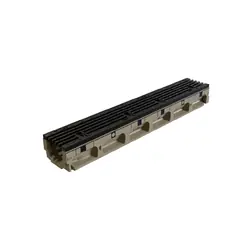
ACO PowerDrain — heavy vehicle collection
Polymer concrete · ductile iron rails and grates
Compare PowerDrain where its documented assembly meets the required truck duty: S100K, S200K and S300K offer nominal 4-, 8- and 12-inch internal widths. ACO documents 0.5% sloped systems and grate-dependent loading through Class F. Select the exact PowerLok or four-bolt grate, retention parts and installation together. Intake area varies by grate and is not installed flow capacity. Compare chemistry and maintenance as well as loading; iron rails do not establish acid resistance. See ACO PowerDrain documentation.
ACO KlassikDrain KS — a stainless rail option
Polymer concrete body · exact chemical review required
KS100, KS200 and KS300 provide stainless edge-rail alternatives in nominal 4-, 8- and 12-inch internal widths. This makes them worth evaluating when galvanized rails are unsuitable; it does not approve them for every aluminum brightener. Check the body resin, stainless grade, grate, joints and cleaning formulation, then the required truck load. See ACO KlassikDrain documentation.
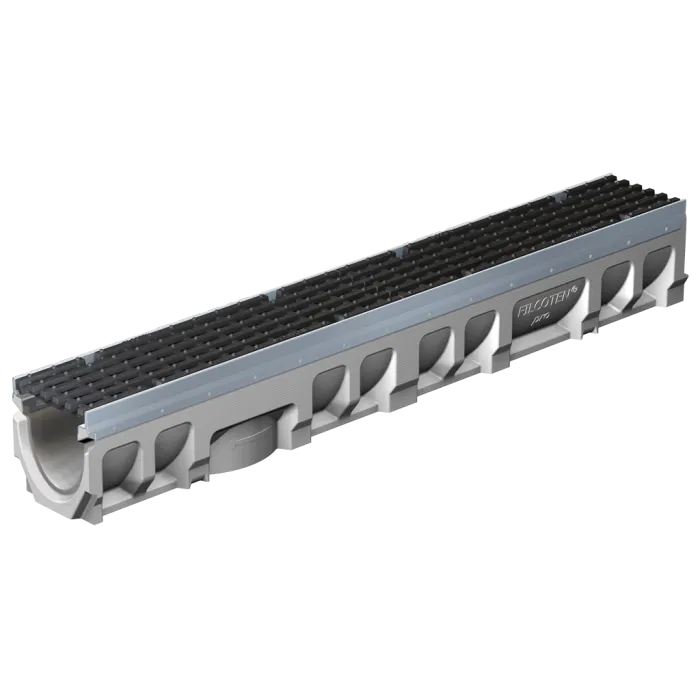
BG Filcoten PRO V 200 / PRO V 300 — wider concrete channels
Grit-heavy collection · size the sump as well as the channel
Compare PRO V 200 and PRO V 300 where channel width and solids-cleaning access matter. The fiber-reinforced concrete body is not a grit treatment system. PRO V configurations use galvanized rails, so they require particular scrutiny where aggressive cleaners reach the edge. Match the chosen grate, locks, sump and support to the specified load; neither a Class E grate nor the Filcoten name establishes every assembly’s rating. See NDS’s US PRO V 200 guidance.
Josam Pro-Plus — composite body with selectable grates
Match chemistry, rails and retention hardware
Pro-Plus 100 and Pro-Plus 200 use an SMC/GRP polyester composite body; stainless grates or edges do not make the drain all stainless. Evaluate the exact grate’s load and opening data with the chemical chart. Josam’s 2026 technical guide contains Class F Pro-Snap rows alongside notes requiring a ductile iron rail for F and excluding Pro-Snap from that rail. Obtain a resolved manufacturer submittal before specifying that combination; do not combine incompatible favorable options.
NDS Pro Series 8″ / 12″ — separate stormwater collection
Perimeter runoff · verify every truck crossing
The 8-inch and 12-inch families can be compared for surrounding runoff where their complete assembly meets the actual loading and capture demand. The availability of an iron or “heavy traffic” grate does not qualify an assembly for arbitrary truck steering loads. If the documented system does not meet that duty, use a suitable heavy-duty channel at the crossing. Keep this collector outside the contaminated wash area’s discharge route.
Catch basins and system sumps — accessible solids collection
Storage and cleanout access · no universal basin size
Compare listed 18-inch and 24-inch basins with matched PowerDrain sumps or a designed larger sediment pit. Check usable volume below the outlet, grit loading, retention time, lifting access, joint tightness and installed traffic support. A landscape basin fitted with an iron grate is not automatically a truck-duty wastewater sump. Settled grit capture also does not replace any required sand interceptor or other treatment.
When collection and an oil separator are not enough
For a retrofit needing aboveground treatment or a wash-water reuse loop, Hydro Engineering’s Hydrokleen range adds purpose-built solids filtration, settling, oil removal and recycling equipment. That is a distinct function from the channel and ACO separator options above. Compare a proposed package against actual flow, contaminants, reclaim-water quality, residuals disposal, energy and maintenance requirements. Manufacturer treatment claims do not guarantee sewer acceptance or eliminate make-up water, purge water or sludge handling. Confirm supply and installation separately.
Build for inspection and maintenance
Decisions to settle before the concrete pour
- Fix the receiving elevations and levels. Coordinate treatment inlet, operating and high-water levels, pipe losses and gravity fall. Locate any required sampling, cleanouts, traps and vents under the approved plumbing design.
- Use the assembly’s installation detail. Follow its concrete support, joint, anchoring, sealant and finished grate elevation requirements. A generic grate recess does not replace that detail or transfer wheel loads away from the grate. Check accessible transitions where applicable.
- Plan solids removal around observed loading. Inspect frequently during commissioning, after unusually muddy vehicles and after storms; set cleanout triggers before storage or flow paths are compromised. Record sediment depth, oil accumulation, blockages and hardware condition. Remove heavy debris before washing where practicable; do not flush accumulated sludge into the next treatment stage.
- Test collection and failure response. Before service, check grades, joint leakage, inlet capture and pump/level controls under representative discharge. In freezing climates, protect exposed pipes and equipment, avoid unintended standing water and provide an operating response to ice. Maintain required trap seals; “drain everything dry” is not a universal plumbing instruction.
Around the wash rack
- Car wash drainage — retail tunnels, self-serve bays, vacuum courts
- Military base drainage — wash racks and motor pools
- Garage & shop floor drainage — where the clean truck goes
- Public works drainage — municipal yards and salt sheds
Fleet and truck wash drainage questions
How do I size a trench drain for a fleet wash bay?
Use measured discharge or the equipment supplier’s simultaneous peak-flow schedule, including reclaim return, tank dumps and backwash. Add rainfall that can enter containment at the same time. Fresh-water consumption per vehicle is not collection flow. Check inlet capture, channel, outlets, pipe losses, treatment rate, storage and receiving levels together; a nominal pipe diameter is not a system capacity.
What EN 1433 load class does a fleet wash rack need?
Use the project’s specified standard and the manufacturer’s documentation for the complete assembly. Include actual service vehicles, wheel and tire details, and crossing movements. Confirm the channel, grate, frame, locks, and installation together; a site label alone does not determine the rating.
Do I need a sand interceptor or oil-water separator, and do you sell them?
The waste stream and discharge authority determine required pretreatment. Drainage Connect lists ACO oil-water separators; confirm the exact model’s flow, solids and oil duty. A grit basin is not automatically an approved sand interceptor, and a free-oil separator does not treat every detergent emulsion or dissolved contaminant. Coordinate any additional treatment, storage or reclaim equipment before fixing outlet elevations.
Will truck wash chemicals damage a trench drain?
They can. Check the actual formulation, dilution, spill concentration, contact time and liquid temperature against the complete assembly’s chemical and thermal limits. Stainless steel, ductile iron and concrete are not universal solutions for acidic brighteners. Include the body, rails, grates, coatings, fasteners, joints and downstream piping in the review.
Does a truck wash pad need a french drain?
A French drain is not a wash-water disposal system. Collect truck-wash water on the designed pad and route it through the required solids capture, treatment or reclaim equipment to the approved outlet. Separate subsurface drainage may help clean groundwater around the site, but it must not become a path for detergents, oil or contaminated runoff into the soil.
Speccing a wash rack or fleet wash bay?
Send the bay layout, equipment peak flow, heaviest vehicles, cleaning chemicals and downstream invert elevations. We’ll review suitable options, confirm availability and lead times, and prepare a quote.
Compare configurations and confirm availability — shop channel & trench drains. Prefer to talk? Call 803-324-3225, email [email protected], or use the contact form.