


Public Works Drainage & Grate Replacement
Drainage by Application · Commercial & Municipal
Public works teams maintain drainage installed across many projects and product generations. This guide covers identifying existing castings, documenting fit and loads, choosing collection for streets and municipal facilities, and separating runoff from washwater and salt-handling wastes.
The right-of-way you inherited
A municipal inventory can include subdivision inlets, older downtown castings, park basins, ballfield underdrains and plaza channels. Similar-looking grates may have different seats, locks and supporting structures. Start each replacement with the asset location, markings, measurements, original detail if available, and the reason for failure.
An arterial gutter inlet under refuse trucks, a courthouse plaza, a leaf-covered park basin and a salt shed apron have different hydraulic, loading and discharge requirements. Record the actual maintenance vehicles as well as everyday users. A pedestrian area can still receive delivery trucks, sweepers or snow-removal equipment.
A broken, missing or rocking grate requires the agency’s immediate hazard-control procedure while the repair is assessed. Replacing the cover alone will not correct a failed frame, undermined support, altered paving grade or overloaded outlet. Decide whether the work is a compatible component replacement, a frame-and-grate replacement, or a structural and drainage repair before ordering.
How water moves through a system nobody documented
For a curbed street, trace runoff to the gutter and evaluate its depth and spread across the pavement. At a plaza or service yard, survey the actual surface falls and run-on paths instead of assuming water reaches the nearest drain. Establish the agency’s design storm, allowable ponding and overflow route.
- On-grade inlets can bypass flow. Capture depends on grate or curb-opening geometry, gutter crossfall, longitudinal slope, approach flow and debris. Carry bypass into the next inlet’s calculation; a particular street slope does not establish a fixed capture percentage.
- Sag inlets depend on ponding head and an overflow plan. Check blockage and the larger check storm required by the agency. A larger grate, curb-and-grate combination or flanking inlets may be appropriate; a trench is not automatically the answer. TxDOT’s inlet guidance explains the alternatives and their maintenance limitations.
Illustrative rainfall volumes: 1,000 square feet × 1/12 foot × 7.4805 gallons per cubic foot is about 623 gallons per inch of rain. A hypothetical 200-by-30-foot paved block receives about 3,740 gallons in a one-inch event; a quarter-acre lot receives about 13,580 gallons in a two-inch event. These are rainfall volumes before infiltration, surface storage and other losses, not peak drain flows. Add contributing roofs and driveways without double-counting their areas. The runoff calculator and runoff guide can support an initial estimate with project rainfall and runoff assumptions.
Before upsizing a casting, check inlet capture, channel capacity, outlet losses, pipe diameter and condition, and downstream water level. A larger opening may improve interception while leaving a downstream bottleneck unresolved. Pipe slope follows the hydraulic design, cover and outlet elevations; there is no universal 1–2 percent minimum for every storm lateral. Use FHWA HEC-22 with the applicable local criteria for pipe velocity, losses and hydraulic grade line.
What a public works department needs
Identify the collection components and the infrastructure they connect to. A catalog listing establishes a product option; it does not establish inventory, agency acceptance or a complete project package.
Catalog options to evaluate
- Replacement grates in iron, galvanized and stainless steel, plus decorative and atrium patterns
- Square and round catch-basin families, with model-specific kits, risers, outlets and adapters
- NDS, BG Filcoten, ACO and Josam channel systems with different traffic assemblies
- Pop-up emitters, dry wells and drainage fittings for suitable facility and landscape systems
- Valve boxes and marked covers, selected by exact duty and utility requirements
- Listed ACO Oleopator and Spill Control equipment for specified oil-separation or containment duties
Infrastructure and approvals to coordinate
- Storm mains, precast structures, curb openings, headwalls and any structural repairs
- Outfall permission, sewer-utility acceptance and applicable stormwater or wastewater permits
- Detention, bioretention and infiltration design, including pretreatment and maintenance
- Pumping where a gravity outlet is unavailable: establish duty flow and head, storage, controls, alarm, failure response and service access
- Waste-stream containment, pretreatment, reuse or off-site disposal; confirm equipment scope separately
Subsurface drainage and surface collection
A turf underdrain or pavement edge drain collects water below the surface; a channel intercepts surface runoff. For fields, cemetery lawns and wet shoulders, investigate soil permeability, groundwater, root-zone construction, pipe spacing, filter compatibility and a maintainable outlet. A generic fabric-wrapped trench cannot guarantee rapid field recovery or serve every pavement section. FHWA pavement-drainage guidance explains why base material, filter location and maintenance access matter.
A conventional French drain uses permeable aggregate with a collection pipe where needed. NDS EZflow is a gravel-free option in the manufacturer’s wider range; confirm the actual configuration and availability. NDS excludes installation under live-load roadways, driveways and parking areas. Keep roof runoff away from problem areas where practical. Swales or bioretention may manage suitable runoff, but a dry well is not a default solution whenever a pipe cannot daylight: check soil testing, groundwater separation, setbacks, contamination and local approval.
Reading a casting: measurements that establish a possible match
A nominal size or photograph alone cannot establish interchangeability. Record both the opening and the grate’s overall dimensions, including any taper, projections, hinge and lock details. Clean the seat sufficiently to measure it, using the agency’s traffic-control and safe lifting procedures.
| Record | How to document it | Why it matters |
|---|---|---|
| Opening and grate dimensions | Length and width, or diameter, of the clear opening, receiving recess and overall grate. Measure both ends and note taper; record dimensions to 1/16 inch where practical. | Clear opening is smaller than the cover that bridges it. Nominal size alone can conceal incompatible bearing or clearance. |
| Grate thickness | Measure the bearing edge and any deeper ribs or projections separately. | Correct seating and underside clearance prevent rocking, interference and an unintended surface lip. |
| Seat and retention | Record recess depth, bearing width, support continuity, bolt locations and hinge/lock geometry. Photograph cracks, wear and spalling. | The frame, locks and surrounding support must transfer the actual loads; fitting inside the frame is insufficient. |
| Identification and duty | Photograph foundry marks, material grade, part numbers and agency detail numbers. List wheel loads, tires, speed and exposure. | Material appearance does not establish load class, corrosion performance or approval. Verify a proposed replacement against a manufacturer drawing. |
Photographs help show orientation and visible damage, but do not prove hidden concrete, anchorage or foundation condition. A sound, documented compatible frame may accept a replacement grate. Where compatibility or support cannot be established, evaluate a matched assembly and any required structure repair.
The vocabulary a purchase order needs
- ASTM A48/A48M specifies gray iron. Its tensile classification is based on test coupons; casting sections may differ from coupon values. Class 30 and Class 35 refer to 30,000 and 35,000 psi minimum tensile test values in the inch-pound designation. See ASTM’s scope.
- ASTM A536 specifies ductile iron. Grade 80-55-06 denotes minimum tensile strength, yield strength and elongation of 80 ksi, 55 ksi and 6 percent under the specified test conditions. ASTM A536 is a material specification, not proof that a grate will survive a plow strike or remain safe after bending.
- AASHTO M306 addresses drainage, sewer, utility and related castings. Supply the project-adopted edition and required certification. The M306-10 text includes proof-load and inspection provisions and country-of-origin documentation; it accommodates different foundry locations. M306 compliance alone does not establish compliance with a separate domestic-melt or Buy America requirement.
- EN 1433 class designations A15, B125, C250, D400, E600 and F900 refer to specified test forces in kilonewtons. They are not permissible vehicle weights. Check the channel, grate, frame, retention and installation as a complete assembly.
- NDS letter classes, EN classes and AASHTO designations are not interchangeable. A matching letter, PSI conversion or generic H-20 label does not establish M306 compliance. Use the load recommendation guide to identify the documentation needed, then obtain the actual assembly submittal.
For covered accessible floor and ground surfaces, ADA 302.3 generally limits openings to those that will not pass a sphere larger than 1/2 inch. The long dimension of elongated openings must be perpendicular to dominant travel. Check the installed opening, surface stability, slip resistance and changes in level; a marketing label alone is insufficient. Bicycle routes also need the agency’s bicycle-compatible pattern and orientation. See our accessible drainage guide and pedestrian application guide.
Confirm compatibility and approval requirements
Attach the standard drawing, approved-products entry and specified testing or origin documentation. A discontinued pattern may require a replacement frame and grate. Do not grind bearing surfaces, improvise locks or mix manufacturers’ components without documented acceptance of the resulting assembly.
Where each piece lands on municipal property
Street, arterial and gutter inlets
Use the agency’s accepted inlet and load details. Record refuse trucks, buses, fire apparatus, sweepers and plows, including wheel loads, tires, speed and turning or braking. Curb-opening or combination inlets can be useful where the site permits them. A trench across a traffic lane needs explicit product suitability, structural support, secure retention and hydraulic review; an EN D400 or higher grate label alone is not roadway approval.
Plazas, sidewalks, transit pads and civic hardscape
Choose between point inlets and linear interception from the actual grading and discharge route. A channel can simplify collection along an edge, but the paving must still drain to it. Select accessible openings and appropriate heel resistance, check maintenance-vehicle access, and coordinate the finish transition. Decorative grates remain an option when their fit, loading, opening geometry and cleanability satisfy the same requirements.
Parks, greenways, medians and cemetery loops
Evaluate leaf litter and sediment alongside mower and service-vehicle loads. Atrium grates can retain exposed inlet area above shallow debris in planted areas. Keep raised domes outside walking, cycling and vehicle paths. Select compatible round or square basins with adequate inlet capture, outlet capacity and cleaning access; a bigger box alone does not solve a sag.
Alleys, fleet yards, wash areas and salt sheds
Map separate water streams before choosing the drain. Ordinary pavement runoff, vehicle washwater, fuel spills and concentrated brine do not share an automatic disposal route. A channel across an apron is useful where grading delivers sheet flow to it, but high velocity, blockage or insufficient outlet capacity can cause bypass.
Keep clean roof and uphill runoff away from washing and chemical-handling areas. For fleet washing, provide collection to containment, reuse, approved treatment or permitted disposal. A sanitary connection requires the receiving utility’s acceptance. EPA municipal washing guidance describes wash-area and pretreatment options. A contained wash operation may use a sump or recovery equipment without a permanent storm connection.
Cover salt storage, recover dry spills and contain brine transfer losses. Capture salt-spreader washwater for an approved management route; brine reuse is an option where its quality and operation permit. EPA deicing guidance supports these source controls. A higher grate load class does not provide chloride resistance, and an oil separator does not remove dissolved chloride. MPCA’s chloride guidance also explains why a conventional wastewater plant is not a chloride-removal solution; local acceptance still needs review.
Drainage Connect lists ACO Oleopator and Spill Control equipment. Select the treatment flow, solids and oil-storage capacity, alarm/shutoff features and maintenance provisions for the actual stream. ACO warns that gravity oil separators cannot separate emulsified oils; detergents therefore matter. These devices do not authorize discharge or treat every fuel, dissolved pollutant or cleaning chemical.
For brine, fuels and hot washing, obtain compatibility information for the channel resin or concrete, rails, grate, seals, joint materials, pipe and any coating. State concentration, temperature and exposure duration. Salted outdoor paving and concentrated brine containment are different exposures. Ordinary soil-tight basin connections are not documented chemical containment.
Utility access and the end of the pipe
A valve-box lid serves utility access, not runoff collection. Match utility identification and security features to the owner’s requirements. Bolt-down retention does not make a plastic box traffic-rated: the NDS 13 × 24 Pro-Spec sheet limits loading to pedestrians and lawn-care equipment. Driving surfaces need a specifically approved box, cover and support arrangement.
A pop-up emitter needs adequate head and a discharge location that will not cause icing, erosion or a public-path hazard. Infiltration and outfalls require site and receiving-system review, particularly for contaminated yard runoff. Select fittings for the actual pipe standard and connection duty, not nominal diameter alone. Browse metal, round, square and channel grates after establishing those requirements.
What to evaluate for the requisition
These product families cover different functions. Confirm the exact configuration, current availability and supporting documents before issuing a purchase order.
12-inch square catch basins and compatible grates
Facility and landscape point collection
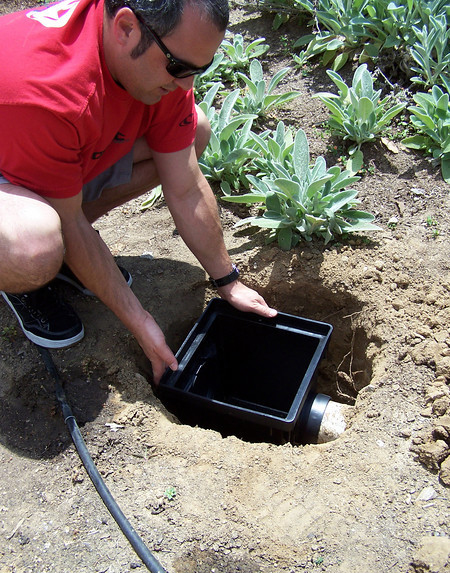
Select from the actual flow, sediment storage, outlet elevation and access needs. 18-inch and 24-inch families offer other geometries; they are not automatic sag-inlet upgrades. A cast iron grate does not independently qualify its basin for trucks.
NDS basin guidance makes installation support and grate loading relevant and identifies model-specific outlet adapters. For kits, verify the included grate and adapters against the required duty and pipe; a bundled kit is not necessarily complete for an existing installation.
Basin risers and outlets and adapters
Model-specific grade adjustment
The listed NDS 9- and 12-inch risers fit their respective basin families. NDS permits trimming those models under its instructions; its 18- and 24-inch risers are not cut-to-height products. These accessories do not fit an unidentified municipal street structure by assumption. Street overlays may require agency-approved adjustment rings, resetting the frame or reconstructing the top. Verify support, retained curb-opening height and finished inlet geometry; use the selected installation detail instead of a universal grate recess.
Ductile iron replacement grates
Documented material and assembly performance
Ductile iron offers a material option with specified elongation, but compare the actual design, seat, retention, load documentation and corrosion exposure. Gray iron can also be appropriate in an accepted traffic casting. Neither material name guarantees survival under a plow, dumpster leg or dropped equipment. A bent or cracked grate needs assessment and replacement as necessary; continued coverage of the opening does not establish safety.
Atrium grates on landscape basins
Raised collection outside traveled surfaces
The NDS 1290 is a documented 12-inch basin-family option for mulched or natural areas. The dome allows water to enter above debris near its base, but can still become obstructed. Check actual fit and loading; locate it outside paths and maintain it through leaf fall. Do not treat it as a substitute for an accessible flat grate.
NDS Dura Slope and its grate range
Qualified low-speed facility channels
The pre-sloped HDPE sequence uses progressively deeper sections; confirm excavation, outlet invert and neutral-section layout. NDS’s 2026–2027 channel catalog identifies DS-200H for the documented Class D assembly and traffic below 20 mph. Obtain matched current grate, frame, fastener and encasement details; older DS-200 instructions are not a hardware substitution guide. DS-240 fits DS-340 catch basins, not channel sections, and is explicitly excluded with DS-200H.
Spee-D and 5-inch, 8-inch and 12-inch Pro Series offer other profiles. Compare depth, inlet openings, actual outlet fittings and complete traffic installation; width alone establishes neither capacity nor suitability for municipal equipment.
BG Filcoten TEC V 100, PRO V 200 and PRO V 300
Concrete channel options for qualified facility locations
The U.S. TEC V 100 specification documents freeze–thaw/salt testing and permits Class D/E with the specified full-concrete installation, but expressly excludes highway use. Do not transfer that permission or restriction to PRO 200/300 without their own documents. Check each rail, grate, lock and installation combination. Salt testing does not establish universal resistance to concentrated brine, cleaners or corrosion of every accessory.
Heavy-duty channels and agency-specific castings
Select by documented assembly and standard detail
ACO PowerDrain S100K, S200K and S300K are relevant candidates for qualified heavy traffic; KlassikDrain offers other grate and edge choices. ACO’s S200K documentation separates grate patterns and retention options. Do not infer pedestrian opening compliance from the highest load option, or approval for concentrated equipment supports from a wheel-load rating.
Josam Pro-Plus uses an SMC/GRP composite body, including when fitted with stainless components. Its 2026 selection table distinguishes ADA-only from ADA/heel-proof patterns. The table’s F-class ductile-rail requirement conflicts with its Pro-Snap compatibility notes; obtain a current submittal and written clarification for the exact assembly rather than combining those features.
For agency-specific castings, request the required pattern, matching frame and certification. The catalog includes EJ and U.S. Foundry brand routes; that does not establish availability of every casting. U.S. Foundry’s utility catalog identifies particular M306 products. Confirm current submittals, project acceptance and purchasing terms instead of assuming a manufacturer-wide certification or quote-only policy.
A different option for continuous roadway interception
Contech Slotted Drain combines a longitudinal inlet with corrugated-pipe conveyance. This outside-catalog comparison is useful where that arrangement suits the roadway geometry. Its standard 1-3/4-inch opening cannot be treated as ADA-compliant; any alternative opening needs separate review. Check agency acceptance, structural installation, corrosion, sediment access and bypass. It offers a different collection arrangement, not guaranteed higher performance than a grate or trench.
Sending a casting to match
- Photograph the installation. Include an overhead view, a low view showing the paving transition, the empty frame if safely exposed, and close-ups of markings, seat and locks.
- Send dimensions and actual traffic. Include all measurements in the table, the specified class if known, wheel loads and tires, speed, turning movements and any equipment supports or plow exposure.
- Attach the governing documents. Include the agency drawing, specification edition, drainage schedule, approved-products entry, prior submittal and any testing or domestic-origin clauses. Record whether the inlet is on grade or in a sag.
- Add purchasing details to the quote request. Provide quantity, location, delivery constraints and required date. Request confirmation of compatibility, documentation, availability and lead time before committing the repair schedule.
Make the next replacement easier
Keep the accepted drawing, component numbers, installation photographs and maintenance record with the asset. Inspect after installation and when storms, leaf fall, sweeping or plowing reveal a problem. Check locks, rocking, wear, concrete support, sediment and outlet condition. Base cleaning frequency on observed accumulation and the agency’s program; recover solids for appropriate disposal rather than flushing them downstream. Arrange safe grate lifting, traffic isolation and access to cleanouts. EPA municipal good-housekeeping guidance supports maintenance procedures and disposal planning.
Related municipal surfaces
Continue with highway and DOT corridors for right-of-way work, ADA and pedestrian drainage for sidewalks, water utility drainage for utility sites, and stadium and recreation drainage for municipal fields.
Public works drainage questions
How do I match a replacement grate to a frame that has no part number?
Provide photographs, clear opening and receiving-recess dimensions, overall grate size, bearing-edge thickness, seat depth and width, and hinge or lock details. Include markings, traffic and the agency detail. Measurements identify possible matches; a compatible drawing and sound supporting frame are needed before accepting a grate-only replacement.
What load class do street and roadway inlets need?
Use the project’s specified standard and complete assembly documentation. Include service vehicles, wheel loads, tires, crossing speed and turning movements. Verify the grate, frame, channel or structure, locks and support together. EN and NDS classes do not automatically establish AASHTO compliance or agency approval.
What is the practical difference between ASTM A48 gray iron and ASTM A536 ductile iron on a municipal casting?
These specify different iron materials and test properties. Ductile iron grades include elongation requirements; gray iron classification relies on tensile test coupons. Neither material designation establishes the finished grate’s traffic rating or guarantees survival of a plow strike. Select the documented assembly and assess damaged castings before returning them to service.
Does a catalog load rating establish AASHTO M306 compliance?
No. Obtain certification for the exact casting and the project-adopted edition. M306 includes material, proof-load, inspection and certification provisions; an EN class or H-20 label alone is insufficient. Check agency acceptance and any domestic-origin requirements separately. M306 compliance by itself does not establish Buy America or domestic-melt compliance.
Our street was resurfaced and the grates now sit two inches low. Do we have to replace the basins?
Inspect the structure and check the agency’s grade-adjustment detail. A sound structure may allow an approved riser arrangement or resetting its frame; damage may require rebuilding the top or replacing the structure. NDS landscape-basin risers only fit their specified families and do not automatically fit street inlets. Restore the required surface and curb-opening geometry using the accepted installation detail.
Which way should grate openings run on a bike route or an accessible path?
For covered accessible surfaces, elongated openings have their long dimension perpendicular to dominant travel, and openings generally must not pass a sphere larger than 1/2 inch. Bicycle routes also need the agency’s accepted pattern and orientation. Check the actual installed grate; rotating an incompatible grate or relying on a label does not establish compliance.
Have a broken casting and no part number?
Send photos, dimensions, cast markings and required load documentation to request a compatibility and availability review.
Working from plan sheets or a standard detail? Use the same quote form, call 803-324-3225, email [email protected], or use the contact form.