


Water & Utility Works Drainage
Drainage by Application · Commercial & Municipal
Plan utility drainage by water source, approved destination and access needs. This guide covers replacement valve covers, yard and building drainage, flushing and backwash flows, and the separation needed around potable-water equipment and chemical handling.
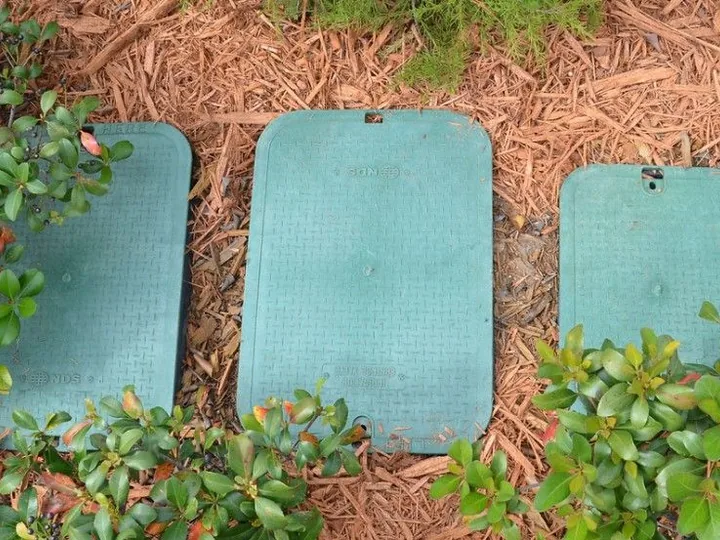
Different settings, different drainage duties
A water utility may maintain meter boxes in lawns, valves in traffic lanes, well houses, treatment buildings, tank aprons and equipment yards. A missing cover, a flooded vault and an overloaded yard drain need different remedies. Identify the asset, survey grades and outlet elevations, and establish where each water stream may go before selecting hardware.
Keep runoff away from wells, vents, electrical equipment and access openings where practical. A replacement lid can restore access protection, but cannot correct groundwater intrusion, inadequate pavement support or a cross-connection. In some chemical areas, a contained floor with controlled recovery is more appropriate than an open drain.
Separate the water streams before connecting drains
| Source or zone | Collection approach | Destination and checks |
|---|---|---|
| Roof and clean yard rainfall | Roof leaders, grading or swales; point basins at low spots and channels across sheet flow. | Approved storm drainage, reuse or suitable infiltration. Check soil, seasonal groundwater, setbacks, receiving levels and overflow routes. |
| Vault seepage and trench groundwater | Exclude water at openings and penetrations first; assess underdrains or an accessible sump where needed. | Characterize the water before discharge. A stone bed or sump does not establish a legal outlet or protect against high groundwater. |
| Hydrant flushing, tank draining and main disinfection | Planned temporary conveyance or collection sized for the operating flow and duration. | Approved receiving route with discharge controls for disinfectant residual, sediment, erosion and any contamination. Do not assume drinking water may enter a storm drain untreated. |
| Filter backwash, reject water and treatment residuals | Dedicated process piping, sumps or equalization sized for batch peaks and solids. | Approved process recycle, treatment, sewer acceptance or off-site handling. Establish limits for solids, salts, pH and other contaminants. |
| Equipment wash and building washdown | Curbed wash area, point or linear drains and accessible solids collection. | Approved wastewater route; determine whether oil separation or other pretreatment is needed. Keep unrelated rainfall out where practical. |
| Chemical unloading, storage and dosing | Compatible containment, segregated sumps and controlled transfer; double containment where specified. | Recovery, treatment or authorized disposal after assessment. Prevent an open path to stormwater and keep incompatible chemicals separated. |
These are design recommendations; the permit, utility standards, adopted plumbing code and receiving-system approval establish project requirements. National pretreatment prohibitions apply to nondomestic discharges to public treatment works, including pollutants that cause interference, obstruction or fire hazards. A sanitary connection is not unrestricted disposal permission. For applicable drinking-water plants, the EPA Filter Backwash Recycling Rule governs specified recycle practices; it is not a blanket authorization to recycle every waste stream.
Protect potable-water interfaces
Keep potable supply piping and equipment outlets protected from wastewater and floodwater. Do not submerge a hose end in a sump or run an equipment discharge into a receiver in a way that defeats the required air gap. Select air gaps or approved backflow protection for the actual hazard and pressure conditions under the applicable code and utility program. EPA’s cross-connection manual explains these mechanisms. A purple cover identifies service; it cannot prevent backflow.
Provide capacity for the specified relief discharge at backflow assemblies, along with access for inspection and testing. Locate air-valve vents, tank overflows and other potable-water openings so a flooded drain or vault cannot become an ingress route; use the utility’s approved details. As a contamination-control recommendation, avoid direct storm or sanitary sewer connections from potable-water valve chambers, blowoffs and air-valve discharge piping; confirm the approved separation and drainage arrangement with the utility. A drainage check valve does not replace potable-water backflow protection.
Surface collection and subsurface water
Use a catch basin where grades converge and a channel where water crosses a threshold or apron as a sheet. Correct settlement or restore intended grading when that addresses the cause. Utility-trench bedding can convey groundwater toward a vault; assess trench cutoffs, sealing, groundwater control and any structural or buoyancy effects separately from surface drainage.
NDS EZflow is a gravel-free subsurface drainage option in the manufacturer’s wider range; confirm sourcing and configuration. Its function differs from a surface channel. Do not use an infiltration trench as chemical containment or as an assumed outlet near a well or vulnerable aquifer.
Working out what you actually have to move
Illustrative rainfall calculation: 1,000 sq ft receiving one inch of rain represents about 623 gallons before losses. For a 60 × 100 ft paved yard, the Rational Method screening calculation Q ≈ CiA uses C = 0.95, i = 4 in/hr and A = 0.138 acres: about 0.52 cfs, or 235 gpm. This assumed intensity is not a local design storm. Select intensity for the adopted event and time of concentration; soil, surface condition and slope affect the runoff coefficient. Our runoff calculator and Sizing for Storms support initial estimates.
Illustrative pipe check: Manning’s equation with n = 0.013, full circular flow, actual internal diameters of 4, 6 and 8 inches, and friction slope 0.01 ft/ft gives approximately 85, 252 and 542 gpm. These idealized values omit entrance and fitting losses and do not rate a drain outlet. The 6-inch example leaves little margin above 235 gpm; it does not establish an adequate design. Check inlet capture and bypass, channel conveyance, outlet head, pipe losses, tailwater and blockage together. Determine pipe slope from the design and applicable requirements, not a universal 1–2% rule. See FHWA HEC-22.
Where pumping is needed, check the duty point against static lift, losses and receiving level, plus solids handling, controls and storage during outages. Provide an alarm and backup provisions appropriate to the consequence of flooding. A clear pipe with recurring ponding may indicate inadequate inlet capture, adverse grades or tailwater as well as insufficient pipe capacity.
Flushing is an operating event, not a design storm
An illustrative 1,000 gpm flush lasting ten minutes produces 10,000 gallons. Obtain the actual flushing, tank-emptying or backwash schedule and peak rate, then assess simultaneous rainfall where relevant. Plan temporary hoses, diffusers, storage or another authorized route when permanent drainage cannot accommodate the event. Vegetated discharge is only an option where approved and where soils, erosion control and water quality allow it.
Confirm dechlorination, monitoring and discharge conditions with the authority responsible for the receiving water or sewer. For example, California maintains a drinking-water-system discharge permit program; its conditions are not a national rule. Contamination-response flushing requires a plan for the contaminants present, beyond ordinary residual-chlorine control.
The lid that fits: matching replacement covers
Record the manufacturer, series and part numbers before relying on nominal size. Compare the old cover and the sound box rim with the current dimensioned drawing. If the rim or support is cracked, distorted or unsuitable for present traffic, evaluate a complete replacement.
Measure both the cover and the opening
Nominal labels such as “10-inch round” or “14 × 19” do not uniquely define the cover or seat. Measure outside cover dimensions, clear opening, bearing ledge and relevant underside features; include units and practical measurement accuracy. A tape measurement to about 1/16 inch can help, but is not an acceptance tolerance or proof of compatibility.
Drop-in, overlapping or secured covers
A drop-in cover rests inside the rim; an overlapping cover extends over it. Record seat depth on opposite sides, cover thickness, locking features and bolt spacing. A bolt-down cover must match the box’s hardware. Consider tamper-resistant retention where exposure or past losses justify it, while preserving authorized operating access. Neither a bolt nor a metal lid changes the supporting box’s load rating.
Markings, series and service identification
The listed valve-box range includes NDS Standard and Pro-Spec products, plus replacement covers and universal lids. Similar nominal sizes or numbering patterns do not establish interchangeability. Send photographs of the cover face, underside and rim, and confirm the exact mating parts.
The catalog includes water, sewer, irrigation, reclaimed-water, electrical and telecom legends in several colors. Match the utility’s service-identification requirements. Purple commonly identifies reclaimed water, but labels and colors supplement physical separation and backflow protection; they cannot establish that a connection is safe.
Depth and extensions
For a box replacement or grade adjustment, record finished grade, box height, depth to the operating nut, pipe clearances and tool access. Use only compatible extensions within the manufacturer’s installation limits; resetting or replacing the box may be necessary. Do not stack arbitrary bodies or transfer surface loads onto the valve or piping. Burial depth does not determine whether two lids fit.
Specify the load path, not just the cover material
Recheck the assembly after a regrade, overlay or change in traffic. Identify service trucks, concentrated wheel loads, turning and braking, outriggers and mowing equipment. A pedestrian box does not become traffic-rated when paving reaches it. For example, the NDS 13 × 24 Pro-Spec technical sheet limits that documented assembly to pedestrians and lawn-care equipment.
| Class | Test force | Installation context |
|---|---|---|
| A15 | 15 kN | Pedestrian and cycle-only areas. |
| B125 | 125 kN | Pedestrian areas and car parks; check actual traffic. |
| C250 | 250 kN | Kerb-side contexts; not a blanket truck-aisle rating. |
| D400 | 400 kN | Road carriageways and vehicle parking, subject to assembly and installation. |
| E600 | 600 kN | High wheel loads requiring project-specific selection. |
| F900 | 900 kN | Exceptionally high wheel loads requiring project-specific selection. |
EN 1433 concerns drainage channels; it is not a default classification for irrigation valve boxes. A test force is not a vehicle weight limit. NDS letter classes, H-20/HS-25 designations and AASHTO M306 use different criteria; do not equate them by letters or force conversions. Specify the grate, frame or rails, locking hardware, body, encasement and pavement support together. The load recommendation guide is a starting point for reviewing the applicable product documentation.
AASHTO M306 covers more than proof loading. The publicly available M306-10 text, section 6, uses 40,000 lbf for the H-20/HS-20 proof test and 50,000 lbf for H-25/HS-25, with alternate procedures for smaller openings. It tests the cover/grate with its frame or simulated support and rejects cracks or permanent deformation exceeding 1/8 inch. Obtain certification to the project-adopted edition; this does not establish the capacity of an entire plastic vault or its installation.
For funded work, identify applicable American Iron and Steel and other domestic-procurement conditions. Obtain product-specific origin and compliance records, including any applicable waiver. A foundry’s name or M306 certificate alone is insufficient evidence of procurement compliance.
Where accessibility requirements apply, check the finished surface and openings as well as strength. ADA section 302.3 generally limits openings to a 1/2-inch sphere and requires elongated openings perpendicular to the dominant travel direction. “Heel-safe” marketing does not replace this check, nor does a grate rating establish slip resistance.
Products to compare by the job
These are listed product families and a separately identified outside example. Listings establish catalog presence, not inventory, suitability or a guaranteed sourcing route. Compare exact configurations against the same hydraulic, structural and maintenance requirements.
Round and rectangular valve boxes
Service access in documented landscape and utility settings
Choose opening size and depth for the valve, piping and operating tool. Listed NDS Standard and Pro-Spec boxes include multiple legends and cover arrangements. Keep assemblies without traffic documentation outside vehicle routes. Ductile iron descriptions on selected catalog covers do not establish roadway capacity for the box below.
6-inch and 10-inch universal lids
Replacement candidates for compatible sound boxes
Catalog SKUs 6RND-UC and 10RND-UC offer another matching route. NDS documents the 10-inch SureFit lid for several box brands using flexible retaining prongs. “Universal” does not establish compatibility with every legacy box, an intact load path or vehicle service. Verify dimensions, retention and the applicable installation.
12-inch basins, 18-inch and 24-inch alternatives
Point collection with cleaning access
Compare grate capture, actual outlet fittings, sump depth, debris storage and cleanout access. A larger nominal basin can provide useful working room, but does not guarantee treatment or greater discharge capacity. Confirm compatible outlets and adapters, full installation support and the receiving pipe before choosing a kit.
NDS 5-inch Pro Series and Dura-Slope
Sheet-flow interception with model-specific traffic limits
The 5-inch Pro Series uses polypropylene channel bodies and offers shallow and deep configurations with different outlets. Dura-Slope uses HDPE and progressively deeper pre-sloped sections. Compare required invert depth, run sequence and outlet positions; slab grading is still needed to deliver water to the grate.
Specify compatible grates, rails, hardware and concrete installation from a matched current submittal. The NDS channel catalog identifies configuration restrictions; a heavy-duty frame and a debris bucket are not automatically compatible. Neither family is automatically appropriate for hot or concentrated chemical waste.
ACO PowerDrain, KlassikDrain, BG Filcoten and Josam Pro-Plus
Compare engineered channel assemblies for paved work areas
PowerDrain and KlassikDrain use polymer-concrete channels; BG Filcoten uses fiber-reinforced high-performance concrete; Josam Pro-Plus uses SMC/GRP polyester composite. PowerDrain’s documented ductile iron edge rails and selected heavy-load grates make it a candidate for truck routes when its installation meets the project. Compare the other families on the same load, opening, depth, outlet and support requirements instead of assigning a class to a brand.
Choose the exact model and current installation detail. Do not combine a high-rated grate with incompatible rail or locking options. Josam’s SMC/GRP body is not stainless steel merely because stainless components are selected. Request written resolution if configuration documents conflict.
ACO sanitary stainless drainage
Point drains, floor sinks and cleanable linear collection
The catalog includes floor drains, sinks, cleanouts and grated or slotted trenches for building applications. Use point drainage for localized releases and linear collection where the floor geometry warrants it. For equipment indirect waste, verify the receptor, required separation, splash control and peak flow. Coordinate traps, vents, trap-seal protection, floor waterproofing and accessible solids removal with the plumbing design.
ACO Oleopator, Spill Control and Aquaduct Double Containment
Distinct treatment, retention and leak-containment functions
Oil separation is a candidate for suitable oil-bearing flows, not dissolved chemicals or every detergent wash stream. The linked NS6/1210 is rated for up to 95 gpm; it does not treat the full 235 gpm yard example. Select from oil type, emulsification, solids, treatment flow and approved discharge quality, with accessible inspection and servicing.
Aquaduct’s secondary trench captures carrier-trench leakage for monitoring. Specify compatible materials, sealed connections, leak testing, detection and contained recovery. It does not neutralize chemicals or replace required storage containment, and an oil-spill retention unit is not universal containment for water-soluble reagents.
Flood-exposed vault access: a separate specification
Outside-catalog example where documented water exclusion is needed
BILCO FT-AL/FTD-AL is an example of a gasketed vault hatch documented for a 10-foot temporary topside water head. Its standard specification lists a 625 psf live load; that is not a roadway wheel-load rating. This provides an evidenced flood-exclusion comparison with ordinary access covers, subject to the hatch, structure, penetrations and drainage detail. Confirm project suitability and sourcing separately; no Drainage Connect catalog listing is established here.
For municipal castings, the catalog includes U.S. Foundry items and an EJ category. Send the required frame/cover drawing, legend, load designation and compliance documents for review. Do not assume an unlisted manufacturer, special casting or cart/quote workflow is available without confirmation.
Materials and maintenance belong in the selection
List routine water chemistry and credible spills: hypochlorite, acids, caustic, coagulants, brine, oils and cleaners as applicable. Record concentration, contact duration, peak and continuous temperature, and rinsing practice. Check the body, joints, sealants, gaskets, grate, rails, fasteners, outlet pipe and coatings together. A room-temperature chemical chart does not establish hot-wash performance.
ACO’s stainless resistance table is indicative at 20°C and calls for final compatibility verification; stainless is not a universal answer for treatment chemicals. Obtain manufacturer confirmation for the actual mixture and service conditions, including thermal cycling. Likewise, evaluate polymer concrete, HPC, HDPE, polypropylene and SMC/GRP by the exact formulation and assembly.
Provide removable covers or cleanouts where crews can reach them safely; allow room to lift baskets and remove settled grit. Base inspection frequency on sediment, leaves, wash use and manufacturer instructions, with additional checks after major storms or spills. Inspect joints, locks, frame support, sump controls and containment alarms, and record where removed residues must go.
For roof water, emitters or dry wells are possible downstream components only where grades, infiltration testing, setbacks and approvals support them. Preserve the roof system’s required emergency overflow and keep discharge away from access openings and equipment. Maintain a defined overland route for blocked or exceeded yard drains.
Send the measurements and project conditions
Replacement cover and drainage review checklist
- Cover and opening dimensions. Measured diameter or length × width, clear opening, seat depth, cover thickness and bearing details.
- Identification and retention. Manufacturer, series, all markings, face legend, bolt spacing and locking features; photographs of the face, underside and rim.
- Installation and access. Condition of the rim/support, grade, box depth, operating-nut depth and required working clearances.
- Loads and specifications. Actual traffic and concentrated loads; the utility drawing, adopted standard edition and procurement conditions.
- Drainage duties. Water sources, peak rates and duration, chemistry/temperature, grades and inverts, discharge approval, tailwater and maintenance access.
Use the quote request to submit the information. Dimensions and photographs support matching; final fit, suitability and availability require the applicable product documentation.
Where utility work meets the rest of the site
Read alongside this page: public works yards, highway and DOT drainage, parking lot drainage, and yard and lawn drainage. More resources are in the drainage FAQs hub.
Frequently asked questions
What do you need to match a replacement valve box lid?
Send measured cover and opening dimensions, seat depth, underside features, manufacturer and series markings, and locking details. Include photographs of the face, underside and sound rim. State actual loads and the utility specification. Box depth and operating-nut depth help assess extensions or replacement bodies but do not establish lid compatibility.
My box is called a 10-inch round but the lid measures more than 10 inches. Which number do I send?
Send both the nominal description and measured dimensions, including the rim opening and cover underside. State whether the lid drops inside or overlaps the rim. Nominal size alone does not establish fit; compare the exact series and manufacturer drawing.
What does AASHTO M306 on my standard drawing require?
Obtain compliance with the project-adopted edition for the identified casting and support. M306 addresses materials, manufacture, testing and inspection, not just a single force. Its proof-test procedures depend on loading designation and opening size. It does not certify a plastic box, pavement installation or an EN 1433 class.
Can listed municipal castings be matched to a standard drawing?
The catalog includes U.S. Foundry items and an EJ category. Submit the standard drawing, frame and cover dimensions, legend, loads and procurement requirements for review. Catalog presence does not guarantee an exact match, stock or special-order availability; obtain product-specific documentation before approval.
What size outlet pipe does a utility yard drain need?
Calculate the design runoff and any simultaneous operating flows, then check inlet capture, channel capacity, outlet head, pipe losses, tailwater and blockage. The illustrative 6,000 sq ft paved yard at C = 0.95 and 4 in/hr produces about 235 gpm. That calculation alone does not select a 6-inch outlet or establish installed capacity.
Can flushing, wash water and chemical spills share a storm drain?
Do not assume a shared connection is acceptable. Establish each stream’s contaminants, peak flow and approved destination. Flushing may need residual-chlorine control, wash water may need solids or oil pretreatment, and chemical spills may require segregated containment and recovery. A separator or double-contained drain does not itself authorize discharge.
Need a lid matched, or a casting quoted to spec?
Send lid dimensions, seat depth, cast markings, box photographs, burial depth and load requirements. Include water sources and discharge requirements for drainage work. Product suitability, availability and lead times require confirmation.
Shopping listed hardware instead? Browse valve boxes and covers or the full valves and valve boxes department. Prefer to talk it through? Call 803-324-3225, email [email protected], or use the contact form.